Featured

Winter Sowing in a Snowy Winter Wonderland

Winter Sowing Containers Outside in the Snow

WINTER SOWING TUTORIAL


2024 UPDATE: New Winter Sowing Guide Now Available

I’ve created a PDF Guide to Winter Sowing, which has even more information than the following tutorial. To get this free guide, you need to subscribe to my newsletter and then send me an email requesting it.

Debbie Rea, The Gardener Wife


WHO could winter sow? Anyone!

Yes, even if you’re a beginner gardener, you can start planting some seeds now. Even if it’s freezing cold where you live, you can plant seeds for your garden now. Even if you don’t have grow lights—which, trust me, are a must for most indoor seed starting—you could start seeds now. Winter sowing is easy and possible for anyone. Winter sowing refers to starting seeds outdoors during the winter in DIY mini greenhouses made from plastic containers. The seeds sprout when the weather warms up just like seeds that have fallen to the ground naturally.

WHY winter sow? To get more plants, of course!

Growing plants from seeds is cheaper than buying plants, and starting seeds with the winter sowing method is cheaper than starting them indoors. Plus, it’s a great way to reuse plastic containers instead of sending them straight to the recycling bin. Here are more advantages to this method of seed starting as described by Wikipedia.

https://en.wikipedia.org/wiki/Winter_sowing – 1/20/19

The last one is my favorite! I’m glad I got a screenshot of that page before it was corrected. Like Abraham Lincoln said, don’t believe everything you read on the internet. In any case, it’s thanks to the internet that winter sowing has taken the gardening world by storm. Trudi Greissle Davidoff first coined the term and documented her experiments on www.wintersown.org. Today you can find instructions, photos, and discussions of winter sowing not only on that website but all over the internet.

WHAT to winter sow?

I recommend that you start with the best candidates for winter sowing: seeds of cold hardy or semi-hardy annuals and of perennials that are suited to your growing zone. Trudi has several lists on her website. You can also look for seed packet and catalog descriptions that say things like this: hardy, self-sowing, colonizing, withstand frost, stratify, stratification, or direct sow in early spring/late fall or as soon as the ground can be worked. Using such descriptions and different plant lists, I made my own personalized list of plants that I’d like to winter sow here in zone 5b.

Perennial: a plant that can live outdoors for more than one growing season

Annual:  a plant that can live outdoors for one growing season in your zone

Hardy Annuals can tolerate cold soil and cool weather, down to the low 30s. These plants can survive some frost and snow.

Semi- or Half-Hardy Annuals can tolerate cool soil and cool weather, down to 40˚F. These plants might survive a light frost.

Tender Annuals require warm soil and warm weather. These plants do not do well in temperatures below 50˚F.

You could also grow tender annuals with this method. However, if you have a short growing season like I do, it may not be worth it. Winter sown tender annuals, such as tomatoes, will be smaller than indoor-started seedlings at transplanting time, so harvesting won’t begin until later in the season. That means fewer tomatoes! If I have extra seeds for tomatoes or other tender plants, I might winter sow some, but not all of them. One year I winter sowed celery seeds and also started some indoors under grow lights on the same date. The winter sown celery seedlings were smaller, yet I planted them anyway wherever I could find some room. They never grew to be as big as their brothers, but they were edible.

WHEN to winter sow?

Winter sowing, as the name suggests, is done in the winter—that’s whenever winter is in your part of the world. It doesn’t matter if your winter is freezing cold and snowy or just cool and rainy. And you can do it at any time during the winter. Here in zone 5, some folks start at the winter solstice; others prefer to wait until after the holidays and start in January. I tend to do my winter sowing in February. Once March rolls around, I get more involved in indoor seed starting. I also go outside and start direct sowing cold hardy annuals in my kitchen garden beds. I see no need to buy potting mix and cut up jugs to use this process for seeds that are easily direct sown, straight into the garden soil.

The beauty of winter sowing is that you don’t have to worry about exactly when to sow your seeds. Unlike indoor seed starting, there’s no counting back 6 to 10 weeks from your average last frost date. Let the seeds figure that out! You plant them anytime in the winter, and when the weather is right for them to come up, they will.

Start perennials and cold hardy annuals first; then start the semi-hardy plants; and lastly, start the tender annuals.

If you’re winter sowing tender annuals in a cold zone, however, you might want to put off starting them until March or even April for the tenderest ones. If you sow them sooner and an early warm spell causes them to pop up early, you’ll have to protect those seedlings through any freezes until it’s time to transplant them into the garden. The more tender the plant, the later it should be sown. In general, you should start perennials and cold hardy annuals first; then start the half- or semi-hardy plants; and lastly, start the tender annuals.

Here’s a list of vegetables and herbs, grouped by their hardiness levels. I put this handy chart together for a book that I’m writing, and the book will include a similar chart for flowers.

Hardiness Levels of Vegetables & Herbs

HOW to winter sow?

Prepare the Containers

If you look around the internet or join any winter sowing groups, you’ll see that when it comes to making winter sowing containers, it is to each his own. This is how I do it. You can use any container that is tall enough to accommodate your seedlings as they grow and transparent enough to see your hand through its side. The most popular kind is gallon-size plastic jugs. We drink a lot of distilled water, so I use those. They’re great because they’re already sterile so I don’t have to wash them.

  1. Wash and sterilize the containers, if needed, and then let them dry.
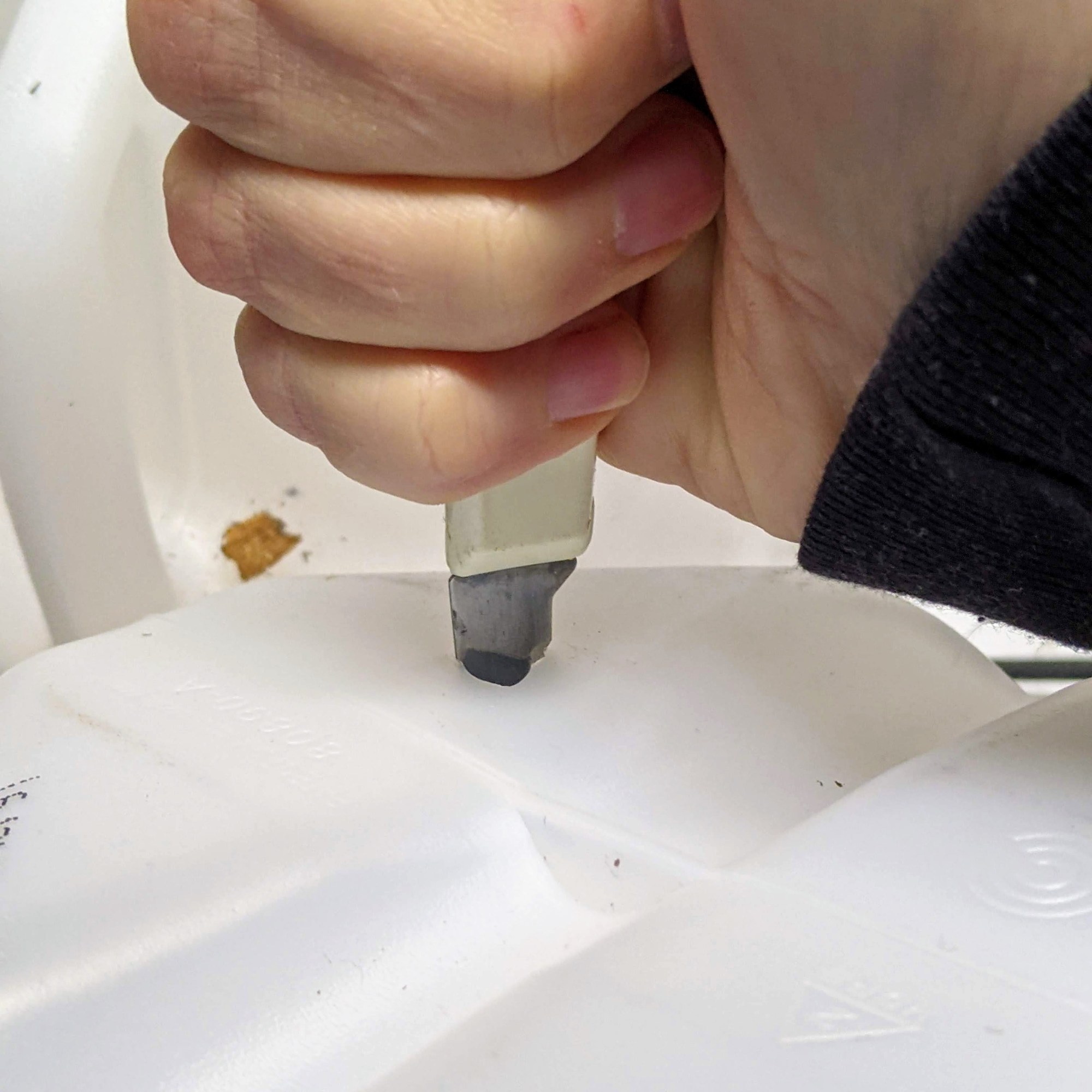
  2. Make drainage holes in the bottom. I create slits with a small knife, and I give it a little twist to make the holes wider—4 holes in each jug. Vent holes are also needed at the top of winter sowing containers, so for these jugs with narrow openings, I just remove and discard the caps.
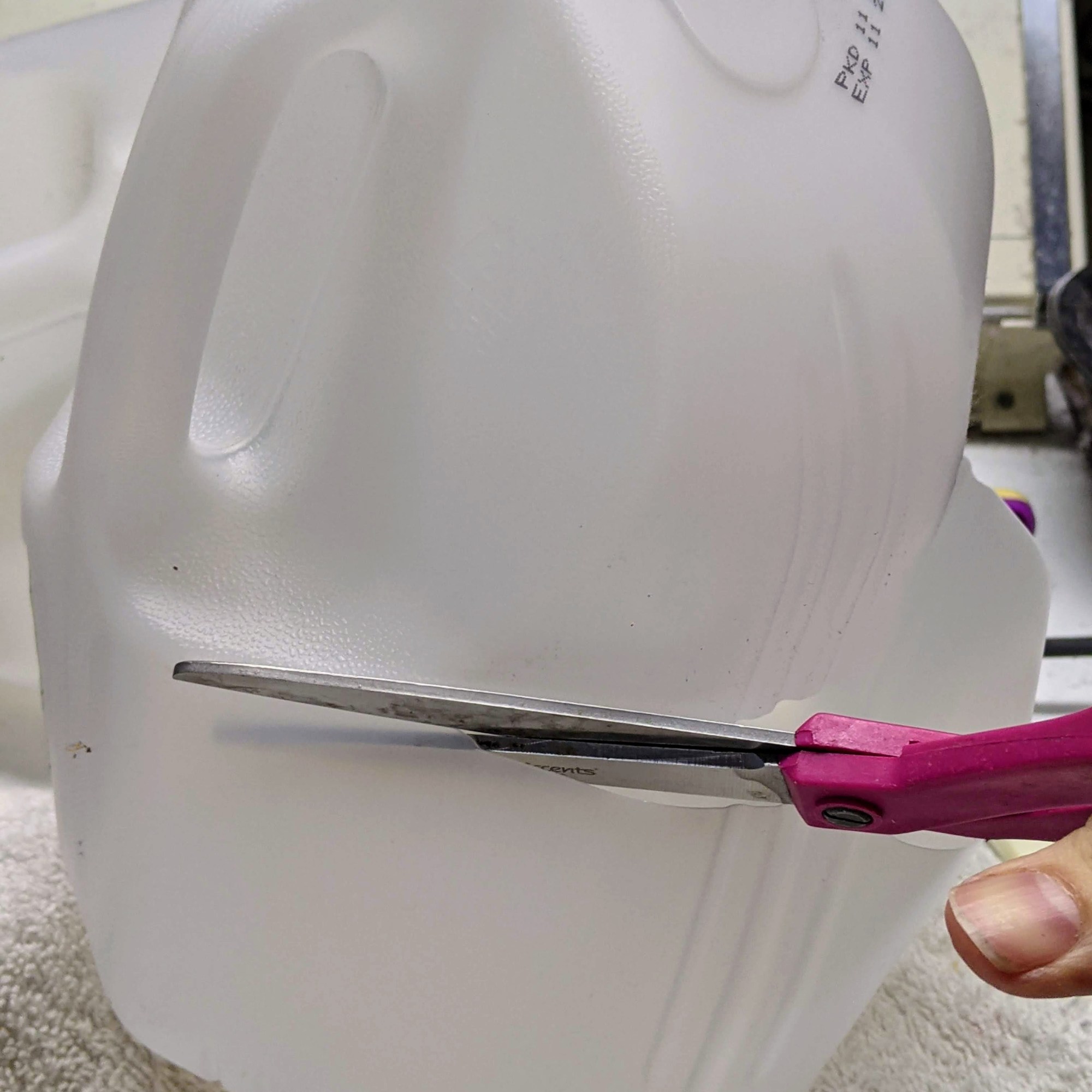
  3. Use scissors to cut almost all the way around the jug about 4 inches up from the bottom and leave a hinge on the handle side. 
  4. Use a hole puncher to punch a hole in the top and another in the bottom at the corner opposite the hinge. This way I can put a twist tie through those holes to fasten my container shut. Most people seal their jugs with duct tape after they’ve planted them. My method is easier than dealing with sticky tape, especially if you have to open and close the jugs later.
Label the Containers
I use a grease pencil. This year I’m experimenting with crayons, too.

I write the name of the seed variety to be sown on both the bottom and top part of the jug because the top parts will get cut off later. Plant only one type of seed per container to avoid confusion. Use smaller containers, such as 2-liter bottles, if you’re planting only a few seeds.

Remember that these containers will be outside for several months, exposed to direct sunlight and all the elements. You do not want your labels to fade, so a Sharpie will not be good enough. I use a grease pencil, but my friend Dolly Foster, who has done much more winter sowing than I have, strongly recommends the Garden Marker, which is waterproof and UV proof.

Fill the Containers

Filling Winter Sowing Containers with Potting Mix

I use a professional quality soil-less potting mix. It must hold moisture and drain well. Pro-Mix no longer makes my favorite kind, which had no fertilizers added. Since I now have to get a mix with fertilizer, I prefer an organic mix, especially when I’m planting anything edible. You may use a non-organic potting mix for winter sowing, if you want, but be sure to avoid any mix with water-storing crystals.

Mix water into the potting mix until it is damp but not soaked (clumpy but not muddy). I fill the containers at least 3 inches, which is deeper than necessary for indoor seed starting. You don’t need a ruler: the rule of thumb is to fill it to a depth that is about the same as the length of your thumb. Tamp it down a bit and add more potting mix until the depth reaches 3 to 3-1/2 inches.

Plant the Containers

The fresher your seeds, the better. When I first discovered winter sowing, I thought it would be a great way to use up my oldest seeds. Wrong! Hardly anything came up, and it was a waste of time and effort. One to three years old is OK for most seeds. I have experimented and found that I can extend the viability of seeds that don’t have a good germination rate after the first year, such as parsley, by vacuum sealing them. In any case, remember that the older the seeds, the more you should plant because fewer of them will sprout.

Small seeds can be sprinkled on top of the soil and patted down into the soil mix. You do not have to worry about spacing them if you plan to use Trudi’s Hunk-o-Seedlings technique for transplanting them later. Larger seeds should be placed farther apart and then covered with a layer of potting mix equal to their proper planting depth, which is usually equal to the diameter of the seed.

The next step is to water the containers, and I do that one of two ways. One method is to put the containers in my kitchen sink and use the sprayer to give them a gentle and thorough watering. The other method is the same one I use with indoor seed starting, bottom watering. I put the containers in trays that are at least as deep as the soil mix is. Then I add water to the trays and let the containers sit in it until their potting mix is soaked; then drain them.

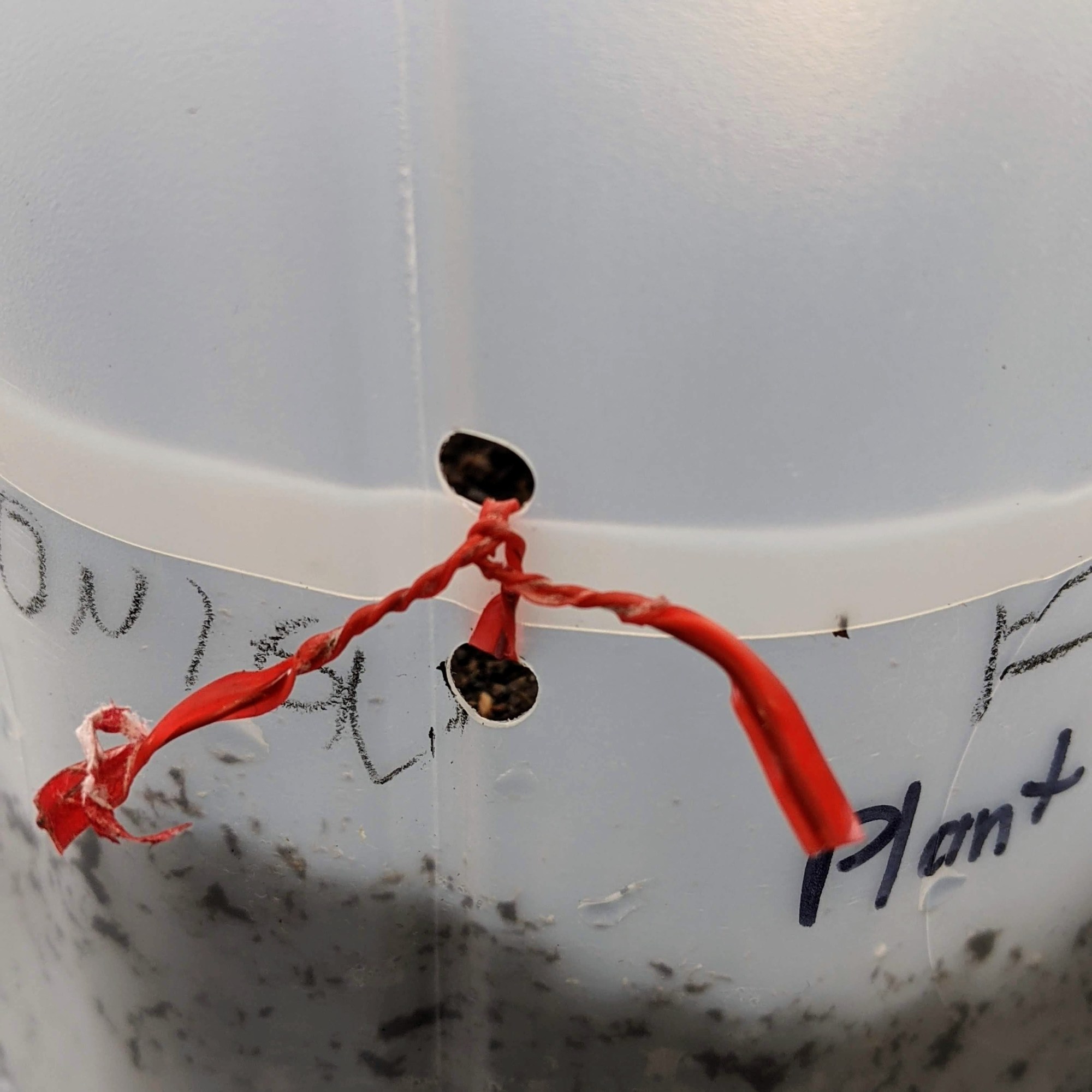
The last thing to do is to cover and tie them. I slip a twist tie through the holes that I punched into the corner opposite the handle of the jug. Fit the top down snugly over the bottom of the jug on all sides, and twist the tie shut.

WHERE to Winter Sow
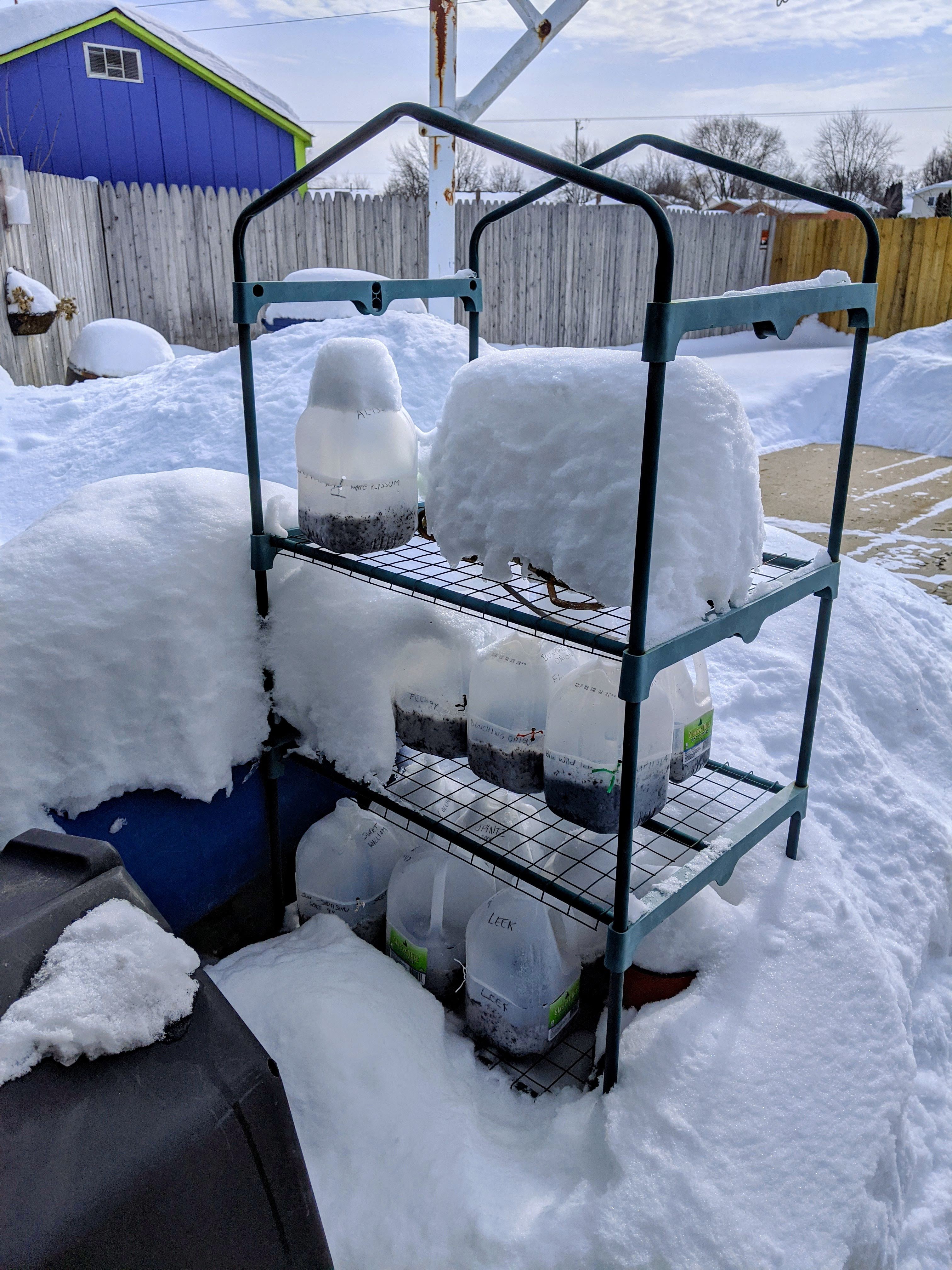
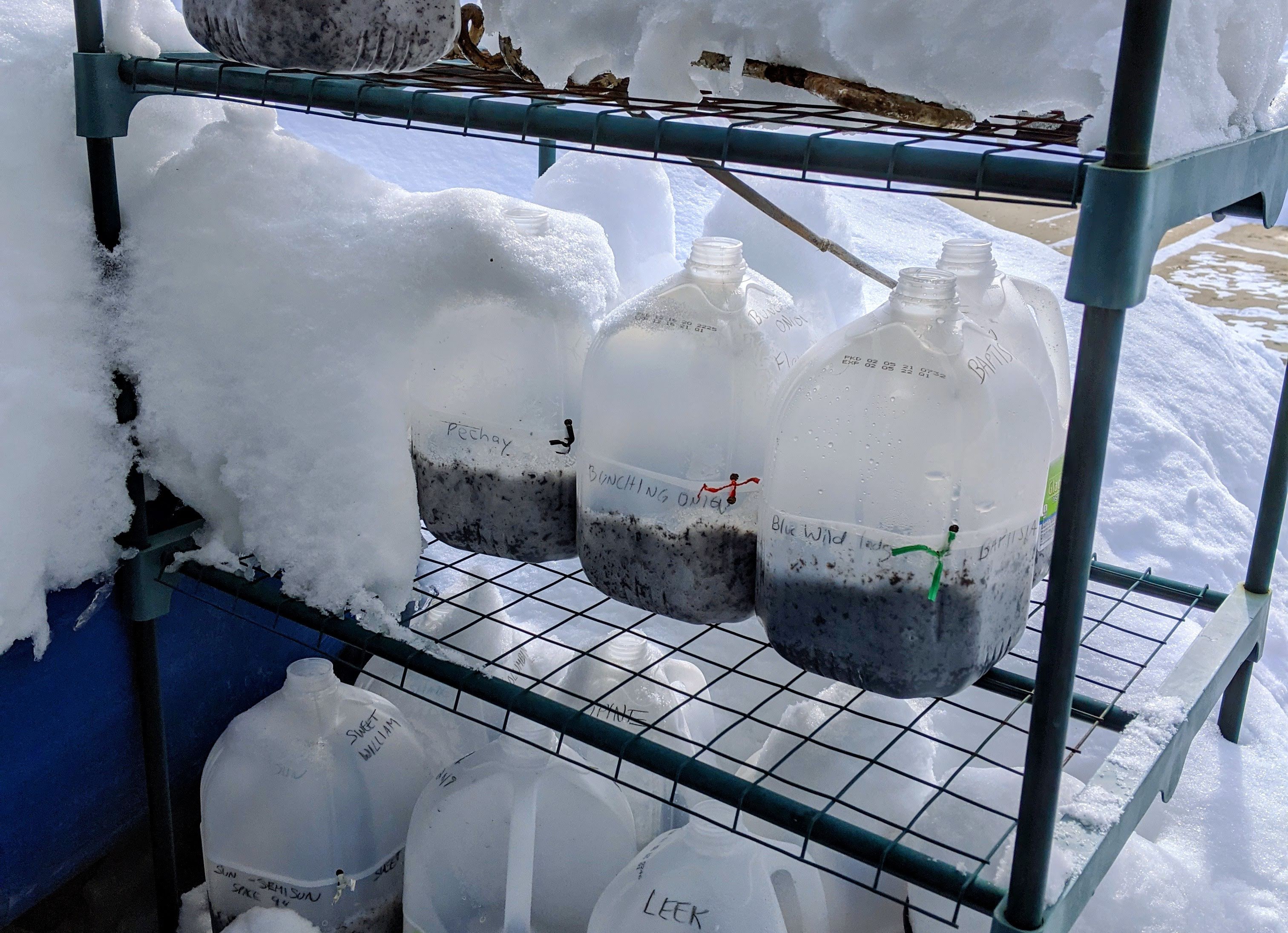
Winter Sowing Containers Placed Outside in the Winter

Now the winter sowing containers are ready to go outside in a sunny spot. They can go anywhere that they won’t be disturbed by pets or other animals—on the ground, on a deck, or on a table. In the past I’ve put mine on wire shelves in the corner between our house and the garage, facing southwest. There they won’t get blown around by a strong wind. It’s also easy for me to check on them because they’re right by the garage door. This year I put them in a sunnier spot, on the shelves further out on our driveway. They’re currently sheltered somewhat by the piles of snow out there.

Maintain the Containers

The beauty of the winter sowing system is that you can set and forget the seeds now to a certain extent. You just need to make sure that they do not dry out. If they’re on the ground and they’re covered by snow, they’re fine. Leave them alone. If they’re not covered by snow, peek inside to see if the potting mix looks dry—even if you see condensation is forming inside the containers. If the surface of the potting mix looks dry or the containers feel light when you pick them up, water them. Check more often as the weather warms up. They may need water on sunny days even when it’s in the 30s. Don’t let the seeds dry out.

Transplant Your Winter Sown Seedlings

Later the magic happens. The seeds sprout and tiny plants start to grow. Don’t worry if it’s too cold for them outside; it’s warmer inside their mini greenhouses. However, if you have tender annuals growing and you think a cold snap is going to lower the temperature too much for them, cover them at night. Water your winter sown plants like you would any other seedlings while you’re waiting to plant them.

Remember that these seedlings are already hardened off. They can be transplanted into the garden as soon as they’ve formed at least one set of true leaves—provided that the soil temperature and weather conditions are suitable for their hardiness level. My advice is that the sooner you can get your winter sown seedlings into the ground, the better. I have left some languishing in their jugs for too long. When I finally planted them, they did not take off. Get those little seedlings planted as soon as you can. Once your garden soil is maintaining a warm enough temperature for the plants’ hardiness level, transplant them outside. You’ll plant them out in the same order that you started them: hardy plants first, then the semi-hardy plants, and then the tender ones.
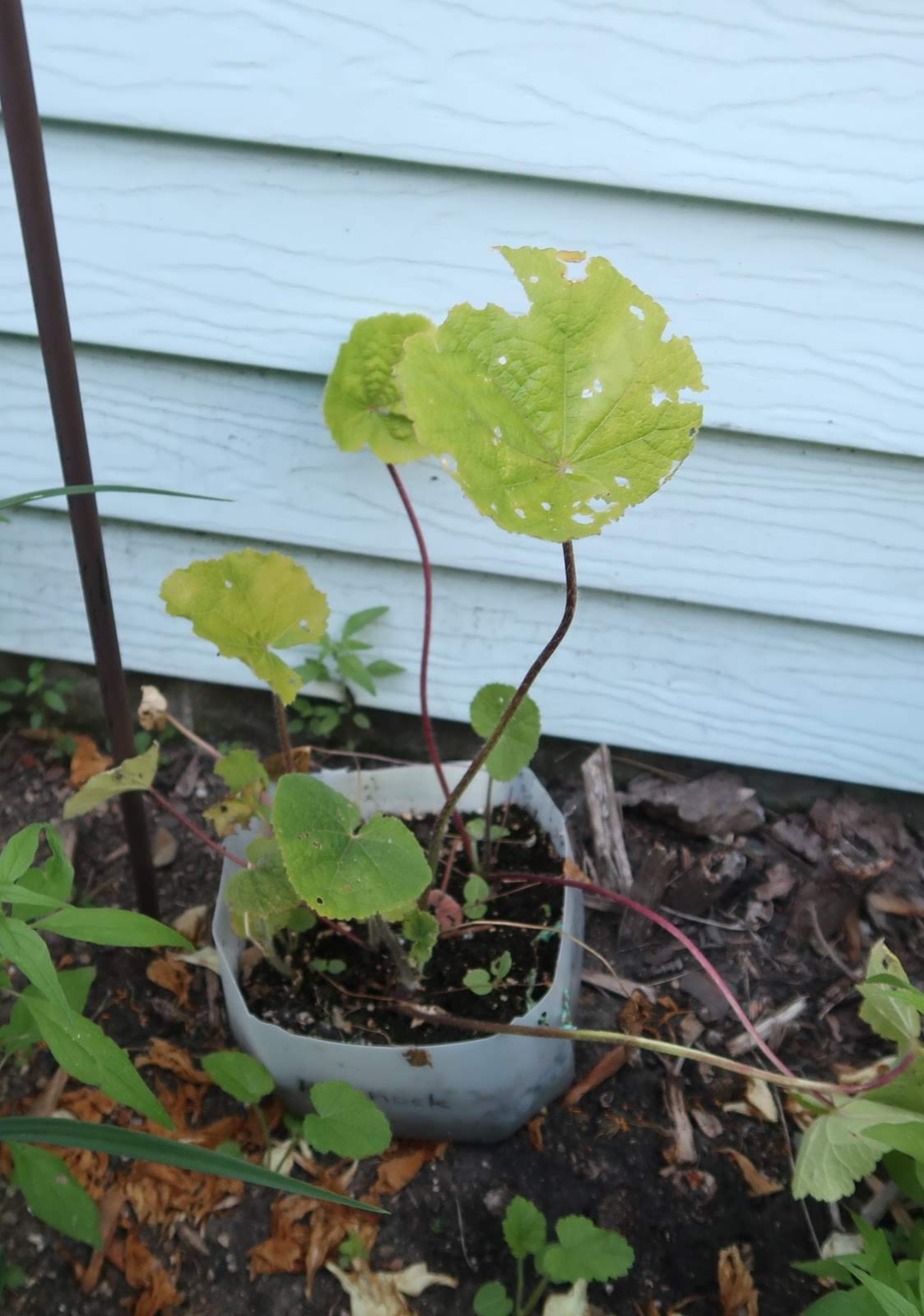
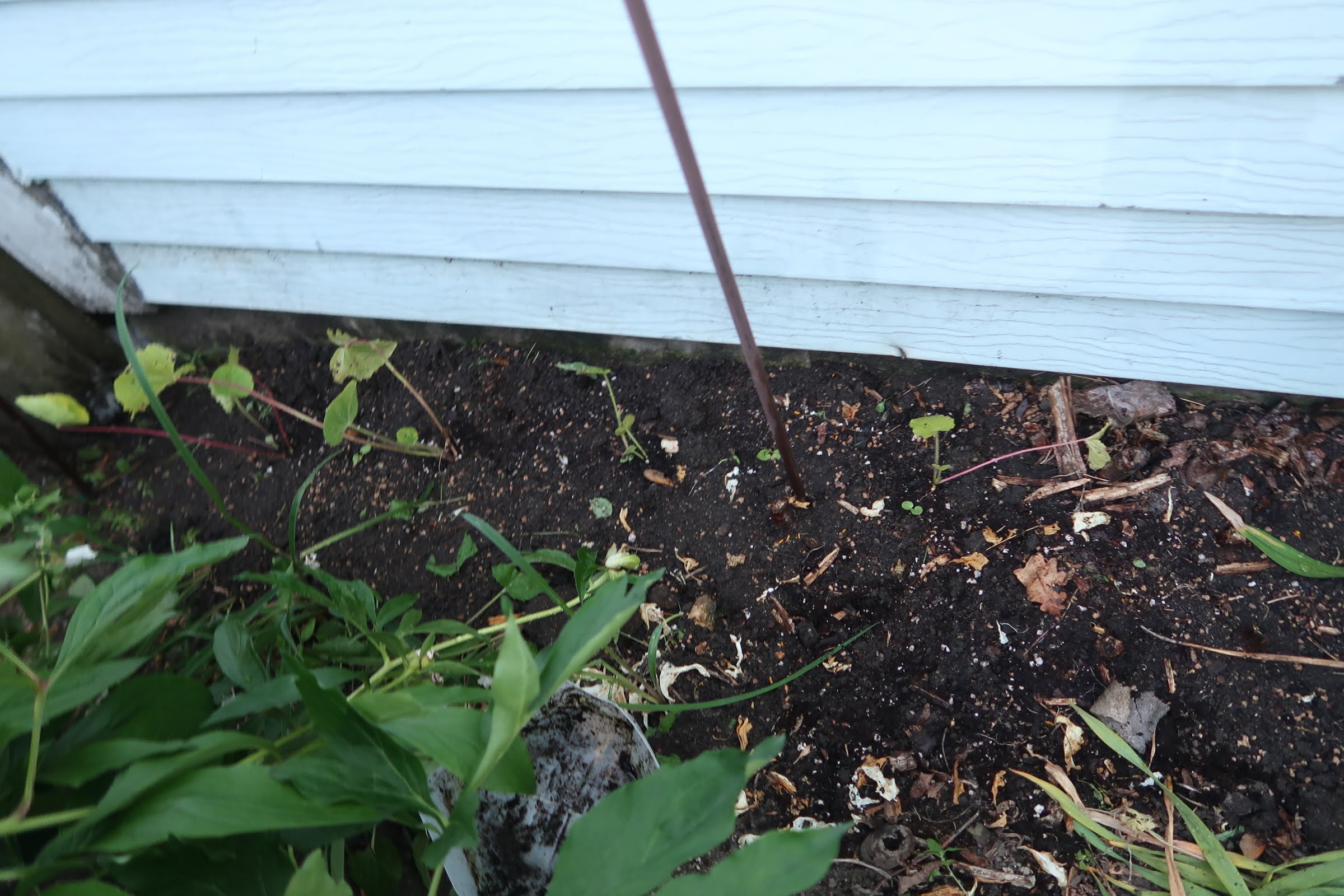
Transplanting Wintersown Hollyhocks

Water the seedlings before you transplant them, and let them sit for a while. When you’re ready to plant them, slide the whole group of seedlings out of the container. If they’re spaced slightly apart from each other, gently pull the individual plants apart, teasing the roots and keeping as much of them as you can with each plant. If the seeds were thickly sown and the plants are all matted together, cut them apart into pieces with a knife. Then use your fingers to pull each piece apart into little clumps of seedlings. Plant those clumps, spacing them as far apart as you would if they were individual plants. Water them in. Keep watering them as needed during the next few days until their roots take and the plants start to grow.

Now you can maintain and enjoy your garden with all these new plants, started from seed.

New Video Demo

You can watch me prepare and plant a winter sowing container from start to finish here on YouTube. If you like the video, please give it a thumbs up and leave your comment or question in the the comments section.

Still have questions? Leave a reply in the comments below to ask them.

Debbie Rea

What about starting seeds indoors?

I’m glad you asked! I’ve been seed starting with traditional indoor methods for longer than I’ve been winter sowing. I recently added information about supplies needed for indoor seed starting to the Shop with The Gardener Wife page.

If you want me to write a tutorial for indoor seed starting, please let me know by leaving a reply in the comment section below.

I may earn commissions for purchases made through any Amazon links in this post. See disclosure here.
Butterfly Pea Flower: Germination Tips and Tricks

How to Grow the Magical Color Changing Edible Flower!

I may earn commissions for purchases made through any Amazon links in this post. See disclosure here.
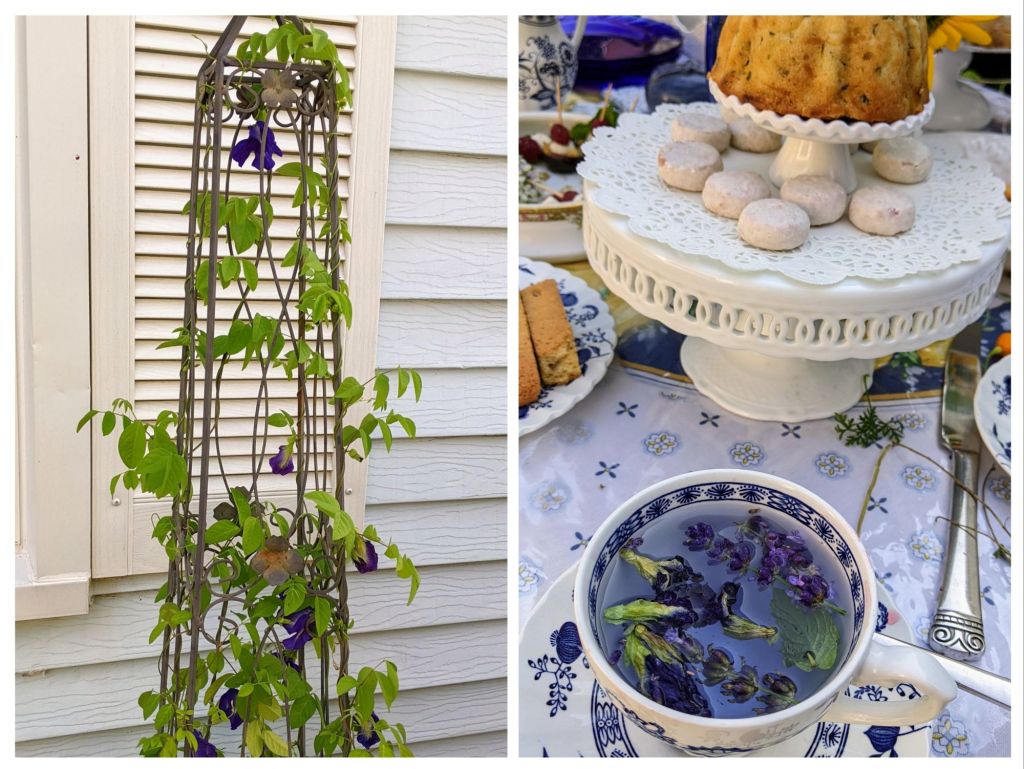
On the left the image shows Butterfly Pea flowers in bloom on a trellised vine. On right the image shows a cup of tea made with Buttefly Pea flowers, lavender buds, and a leaf of stevia.
Growing and Using Butterfly Pea Flowers

I’ve just experienced my greatest success in starting Butterfly Pea flower (Clitoria ternatea) seeds. These seeds are rather difficult to start, so I’m going to share what has worked for me. (If you want to know the secret of my success right away, scroll down to Third Attempt at Starting Butterfly Peas.)

Why Grow Butterfly Peas

First, I’ll tell you why I wanted to grow Butterfly Pea Flower. For one thing, it’s a beautiful purple-blue edible flower. I just love edible flowers! Second, Butterfly Pea flowers can be used as a food dye, and I love the color blue. And last but not least, its color changes from bluish purple to pink when you add something acidic. If you make a blue tea with it, you could add lemon juice and watch it turn pink. How fun is that? You could use it to make your own pink lemonade.

Closeup of Butterfly Pea Flower

By the way, just like with regular peas and snow peas, the leaves and young pods of the Butterfly Pea plant are also edible.

First Attempt at Starting Butterfly Peas

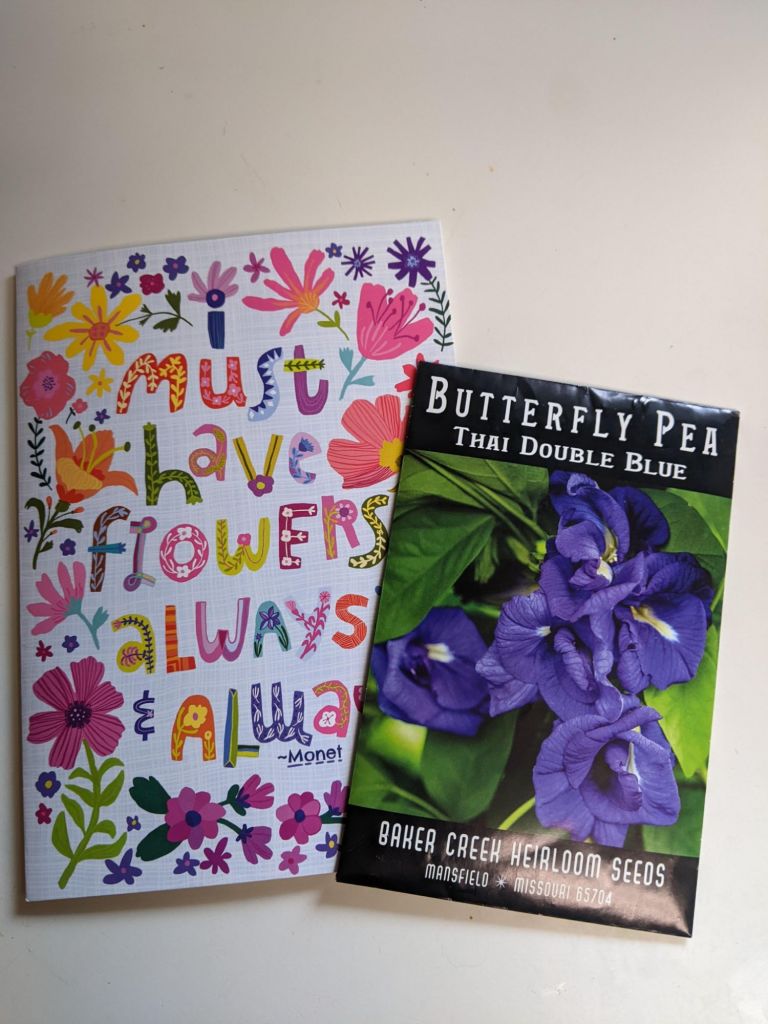
I successfully grew Butterfly Pea flower for the first time two years ago when my friend Heather Andrews, The Thoughtful Gardener, sent me a package of “Thai Double Blue” Butterfly Pea seeds from Baker Creek. The package had only nine seeds in it, so I split them and tried starting four of them indoors and the other five with the winter sowing method. I got them in mid-March, and I was in a hurry, so I don’t even remember if I followed Heather’s tip to scarify them by nicking them with nail clippers. Others recommend filing the seeds or soaking them overnight, and some say to try both filing/nicking them and soaking them. These seeds have a shell that’s tough to crack! Since winter sowing takes care of the scarification process naturally, I skipped it on the winter sown ones.

Butterfly Pea Seeds from Heather

The result was that only one seed sprouted. It was one of the winter sown ones, not one of the ones I’d started indoors. That’s surprising because I learned later that Butterfly Peas do not tolerate cold or even cool weather very well. Apparently the winter sowing jug not only took care of scarifying that seed but also kept it warm enough to germinate. Since Butterfly Peas do not like cold temperatures, it’s best to wait until spring if you’re going to use the winter sowing method.

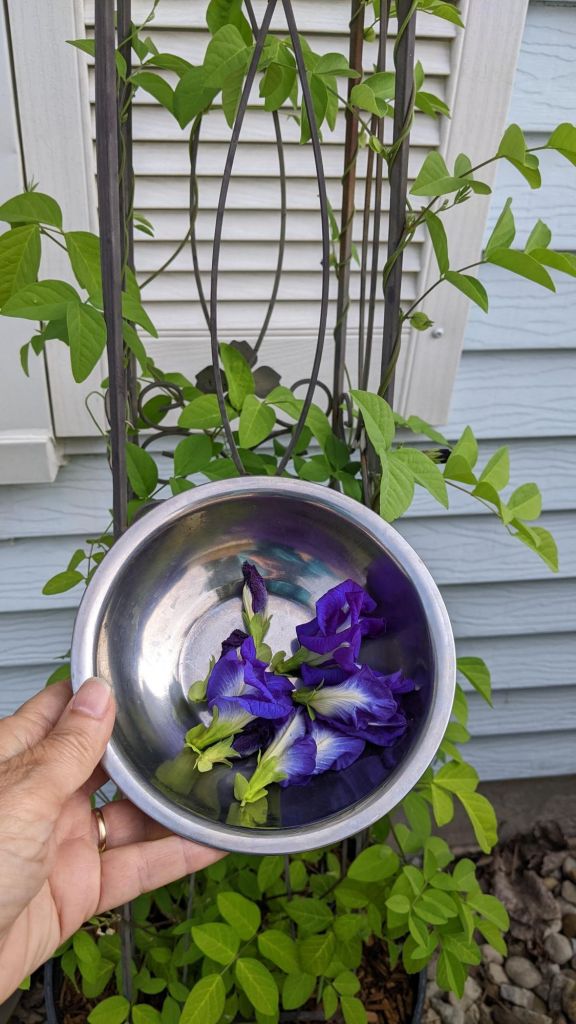
I planted that seedling in a container with a pretty trellis support. Because Butterfly Peas need lots of sun and heat, I placed the pot by the driveway on the south side of my house. And that one seedling grew into a nice vine that produced many flowers over the course of the season. I harvested the flowers as they appeared, air dried them, and collected them in a vacuum sealed jar. 

Harvested Butterfly Pea Flowers

Using Butterfly Pea Flowers

The flavor of Butterfly Pea flower tea isn’t that great in my opinion. But it’s supposed to be a healthy tea, reputed to enhance memory, calm nerves, and help against stress and depression. I usually mix it with other herbs that I grow for tisanes. Early that fall I hosted a garden party and let my guests choose plants from my garden to make their own tea blends. I also supplied lemon wedges for additional flavor—and so we could enjoy the fun color change.

Cups of Pink and Blue Butterfly Pea Tea

Second Attempt at Starting Butterfly Peas

One out of nine is not a good germination rate, even for seeds that were a year old. Last year I resorted to ordering seeds on Amazon because I could get ten times as many seeds for only twice the cost. This time I nicked about ten seeds and soaked them overnight before starting them indoors on a heat mat. And because of my winter sowing success the previous year, I put another ten seeds in a winter sowing jug. I did that at the end of March, and one of the winter sown seeds germinated by April 19th. That was all. No other seeds came up.

Then I got distracted by other projects and failed to get that one little seedling transplanted in time for it to do well. I still had some of the dried Butterfly Pea flowers from the previous year, and those were still good to use. Now, however, the ones that are left from two years ago have turned black and green. As an experiment, I just now tried making a tea with them. The flowers turned green, and the water did not change color at all. It smells kind of like peas or spinach.

Third Attempt at Starting Butterfly Peas

The third time is the charm! Since I was still using the Butterfly Pea seeds I bought on Amazon last year, I doubled up and nicked four dozen seeds with a pair of nail clippers. Then I soaked half of those overnight before planting them in cell-packs. I put those cell-packs on a small self-watering tray and placed it in front of a heat register in my kitchen. I could have placed it on a heat mat in my basement, where I usually do my seeds starting, but I figured I’d check it more often if it was in my kitchen.

I put the other two dozen nicked seeds in between two damp paper towels, which I sealed inside a zip-close bag. This I placed on top of the plastic heat register extender in our bedroom. I was hoping I’d remember to check it daily. That was on March 27th. After ignoring it this past weekend, I checked it yesterday, April 7. And I found not one, not two, but TEN of those two dozen seeds had germinated! 

Here’s a video of what I found when I checked those Butterfly Pea seeds eleven days after starting them. If you prefer, you may watch it here on YouTube.

Video: Checking on Butterfly Pea Seeds

That’s it! This is the best method for germinating Butterfly Pea seeds. I’m not even going to bother trying the winter sowing method this year. And next year I won’t try the typical indoor seed starting method either, which has failed me twice. I still have a good number of those seeds I ordered from Amazon left. Next year I’ll take about three dozen of those Butterfly pea seeds, nick them with nail clippers, and start them with the damp paper towel method.

Tips for Growing Edible Butterfly Peas

Butterfly Peas are hardy in zones 10-12. In cooler zones like mine, we grow them as annuals. They can go in the ground if you plant them in soil that is well draining. I prefer to grow mine in containers filled with a good quality organic potting mix. Butterfly peas require full sun, and they love very warm temperatures, 75 to 100°F. The flowers bloom for about a day. or so. You can pick them when they bloom or let them shrivel and dry on the vine. 

I planted the two largest of the Butterfly Pea sprouts from the paper towels in a 3-inch pot yesterday, and the rest I planted into an 8-pack of tall cells. I put those on a self watering tray under grow lights in my basement. I will transplant them up into bigger pots as needed. Later I’ll harden them off so I can plant them outside when the soil temperature reaches 70-75°F. Then I’ll plant them in self-watering pots with obelisk trellis supports for the vines. 

Butterfly Pea Planted in a Pot with Support Trellis

Self-watering pots are the way to go with Butterfly Peas because they do best in soil that is consistently moist but not waterlogged. If you don’t use self-watering pots, you must be sure to keep the plants well watered. You could even grow them in a hanging basket if you keep it consistently watered. To prevent fungal problems from developing, avoid getting water on the plant. You should water from the bottom or aim the water at the roots.

The flowers look pretty as they’re growing on the vines, and you can dry them to use throughout the rest of the year.

Have you drunk or eaten anything made with Butterfly Peas? Let me know in the comments below.

Lime Basil—A Must for Every Garden

Lime Basil Plant (Sweet Basil is in the background.)

Lime Basil is THE BEST Substitute for Cilantro!

I always include lime basil among the herbs that I grow during the summer. The plant and its leaves are a little smaller than sweet basil, and it’s just as easy to grow. It became a must-have herb in my garden when I realized that I could use it as a substitute for cilantro. No, it doesn’t taste like cilantro—but it goes well with the same flavors that cilantro does.

I’ve tried other substitutes, and they just don’t cut it. Vietnamese coriander? Bleh! I don’t like its flavor. Parsley? Come on! It might look like cilantro, but it doesn’t add the same kind of zing that lime basil does. Dill? Yeah, maybe. It’ll do, and perhaps you could add some lime juice, too. But dill doesn’t last in my garden as long as lime basil does, and I still think lime basil is the better choice. Like cilantro, lime basil can add a nice herbal tang to salsa.

No, lime basil doesn’t taste like cilantro—but it goes well with the same flavors that cilantro does.

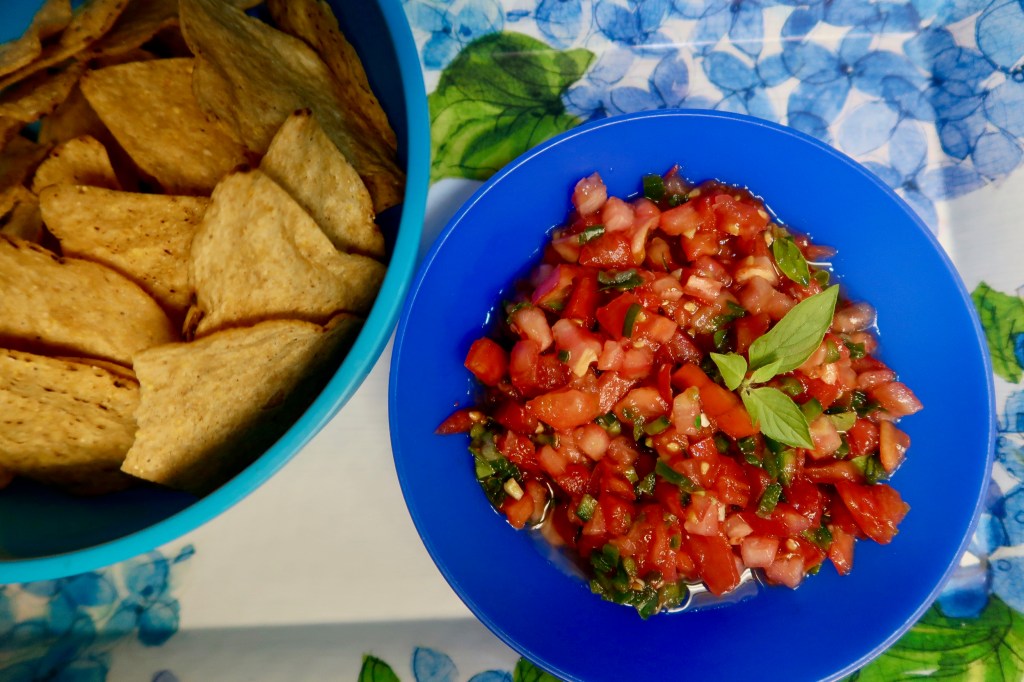
Try making salsa with lime basil when cilantro is not available.

Why Do We Need a Substitute for Cilantro?

Cilantro is a “love it” or “hate it” herb. Studies indicate that our polarization over this herb could be due to something in our genes, but the negative reaction might be overcome with more exposure to cilantro. However, most people who hate cilantro have no intention of trying it until they like it. If you are among that portion of the population that cannot stand the taste of cilantro, I suggest that you try lime basil instead in your recipes. It’ll improve the flavor of your dish without giving you that soapy flavor you detect in cilantro.

Lime basil is even better in mango salsa.

Even those of us who love cilantro often find that we need a substitute for it when it’s too hot for this cool season plant to grow in our gardens. Because cilantro bolts (i.e. goes to seed) so quickly, it is always MIA at salsa time, when my garden is producing tomatoes and jalapeños. One solution is to freeze cilantro for later use when it’s in season. I don’t recommend drying cilantro because dried cilantro does not taste much like cilantro at all. In the past, if I hadn’t frozen some cilantro or my supply had run out, I was stuck with buying it from a supermarket. Now, however, rather than going out to buy cilantro, I can just snip a few leaves of lime basil into my fresh tomato salsa. It’s even better in mango salsa!

Other Uses for Lime Basil

But don’t stop there. You could use this herb with anything that goes well with lime, such as poultry or seafood. Besides putting lime basil in the seasoning or marinade for chicken or fish, you could use it to flavor an accompanying side dish of rice or couscous. I’ve made lime basil pesto to put on pasta and served it with grilled shrimp. You could add it to salad dressings or put some leaves in a salad or on cooked vegetables. I like to make a colorful caprese salad by using several varieties of tomatoes with sweet basil, purple basil, and lime basil. You could also use it to flavor or garnish various beverages, from hot tea to cold lemonade or cocktails. With so many uses, lime basil is sure to be your new go-to herb.

How to Grow Lime Basil

Alas, I’ve never seen lime basil sold in any store so if you want to try it, you’ll have to grow it. Not all garden centers sell lime basil seedlings, but seeds are readily available—even at the big box stores. Just like regular basil, it’s a warm season plant so plant the seeds indoors or after danger of frost. Basil likes well draining soil and full to part-sun. Harvest or trim it regularly to keep it bushy and producing more branches. It’s also good to keep it from blooming, as the the flavor of the leaves alters when flowers form.

All the varieties of basil are very tender plants. The first hint of frost will damage it. You’ll have to give up on lime basil or bring it inside when the temperature gets cold. However, I don’t alway bother with bringing it inside—it can be tricky to keep it alive. If I were smart, I’d plant some cilantro now for when it gets cooler in the fall, when the lime basil will give out on me. Cilantro can tolerate a light frost, and I could cover it to make it last a little longer.

Let me know if you’ve tried growing lime basil, and tell me what you think.

How to Cure and Store Homegrown Garlic so It Lasts Longer

Garlic Harvest - three kinds of harvested garlic

What to Do after Harvesting Garlic

Once you start to grow your own garlic, you’ll want to know how to store your homegrown garlic after you harvest it so it lasts longer. I have been growing garlic for over a dozen years, starting with a bulb of Russian Red garlic that a Master Gardener friend gave me. I added a few more varieties later, and then a couple years ago I narrowed it down to two, Music and Russian Red. Both of these are hardneck varieties, which do well in colder areas like mine.

However, hardneck garlic does not last as long in storage as softneck varieties do. University extension service websites say that you can expect hardneck varieties to last only two to four months while softneck garlic, the kind often sold in supermarkets, could last six to eight months. These times apply to garlic that has been cured.

However, I’ve been able to get my hardneck garlic to last for over a year! Here’s how I did it.

How to Cure Garlic

Hardneck garlic curing on a wire rack
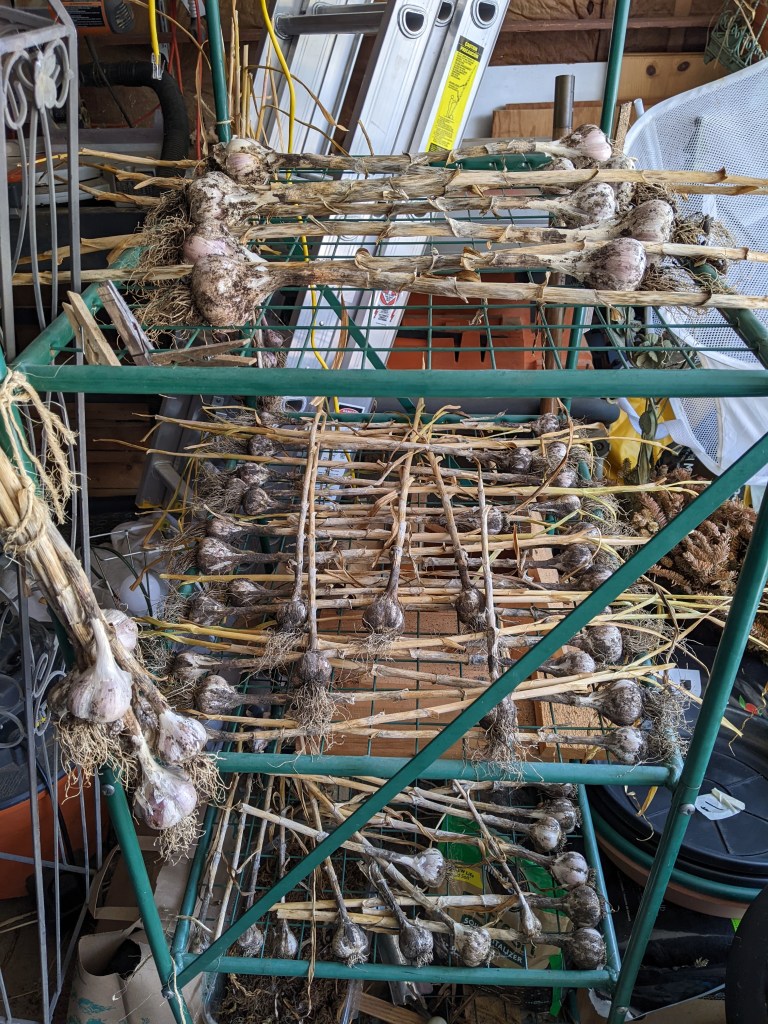
Curing Garlic on a Wire Rack in the Garage

The first step to getting garlic to store longer is to cure it properly after you harvest it. You may start using your freshly harvested garlic as soon as you harvest it, but you should cure any that you are not going to use right away. To cure it, garlic growers generally tie the stalks or leaves of four or five garlic bulbs together and then hang these bundles in a shady place that is dry and breezy for at least a month. I cure mine in our garage. It gets some breezes there when the garage door is open, and I keep it far enough inside so that the sun does not shine on it. Instead of bundling and hanging the garlic, I lay the bulbs out on a wire shelf unit, and they get very good air circulation.

I tend to let them cure for longer than the recommended minimum of one month. I usually leave the garlic on my curing rack until it’s time to plant it in October. I choose the bulbs with the largest cloves to plant because those will produce larger bulbs for next year. The remaining garlic I store for use throughout the rest of the year. Perhaps the extra curing time helps the garlic last longer in storage. Letting the bulbs hang with the root side down may also extend the garlic’s shelf life a bit. 

How to Store Homegrown Garlic

For many years, I followed my Master Gardener coordinator’s recommendation for storing garlic after it was cured. After trimming the roots and stems of the cured garlic, I wrapped the bulbs separately in pieces of newspaper and then put them in cardboard shoe boxes. I kept those boxes in the darkest part of my basement. Some of the garlic that I stored this way lasted up to six months—pretty good for hardneck garlic. Some of it became soft and gummy. But most of it dried up and became rock hard. This video shows the results when I checked my stored garlic in March 2021.

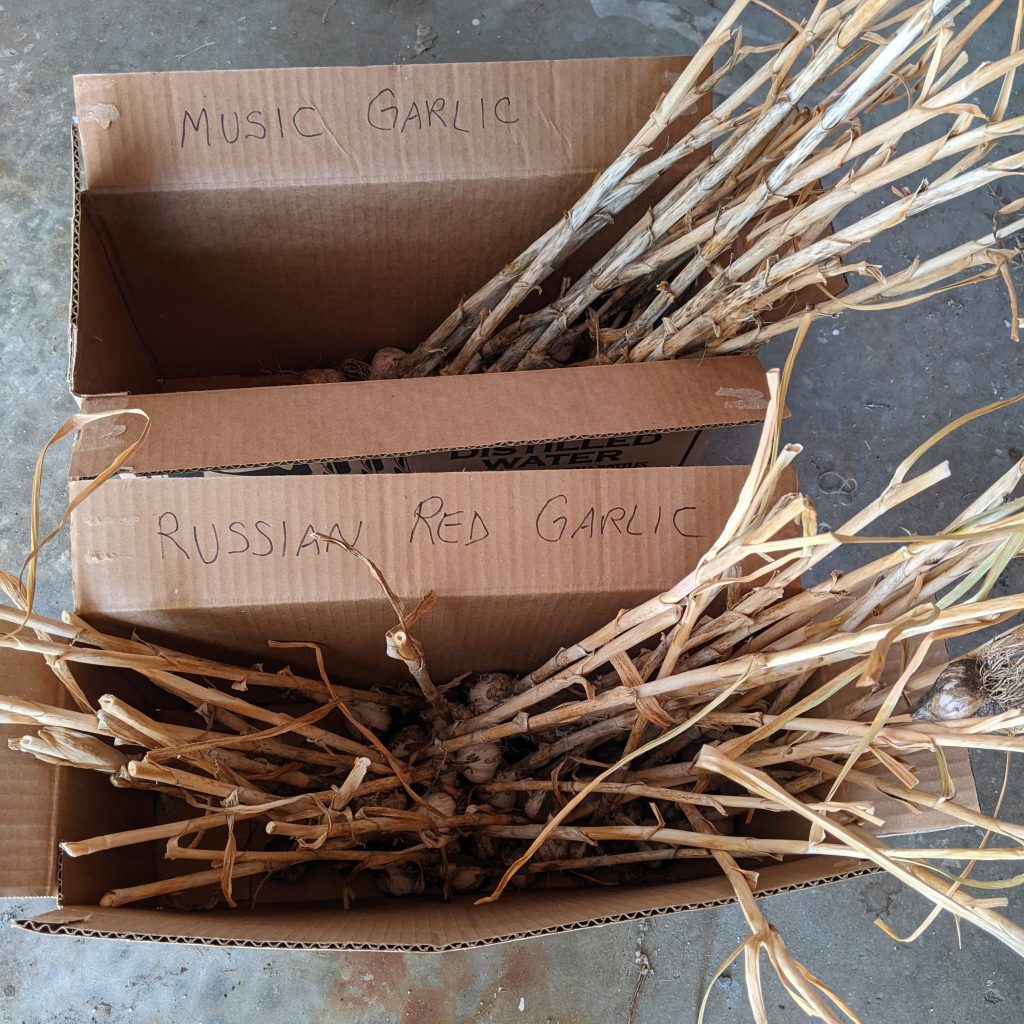
The following year, I discovered an easier and better way to store homegrown garlic. I had left my garlic curing in the garage for an extra long time—after I’d already planted the next year’s crop—and I needed to put it away quickly before our first frost came. I grabbed a couple empty boxes, which happened to be the tall and narrow kind that gallon jugs of water come in, and I put the garlic in there. I was in a hurry so I didn’t trim the stems and roots off, and I didn’t wrap the bulbs in anything. I just stood them up inside the boxes. Because the stalks stuck out a little, I didn’t even close the boxes. Then I put the boxes of garlic in my basement, which is always cooler and more humid than the rest of our house. If you don’t have a basement, put your garlic in the coolest and darkest spot you can find.

long lasting garlic storage
Stand up the garlic, cured and untrimmed, in a cardboard box.
Music Garlic – I like this variety because of how large the bulbs get.

Whenever I needed a bulb of garlic during the following months, I went downstairs and grabbed one from the box. Only then did I cut off its stem and roots. And guess what—the garlic lasted all year long! This method worked so well that I’ve stored my homegrown garlic the same way every year since. I made another video demonstrating my new method for storing garlic: How to Store Homegrown Garlic. This method is an easier as well as a more effective way to get garlic to last longer.

How to Store Homegrown Garlic

I hope you’ll experience similar success if you try my method of storing garlic from your garden. If you have any questions, ask them below. And if you found this article helpful, please like it and share it.

Come Grow with Us

Gardening for Shalom

All Nations Eden Community Garden

I took time off from working on my own garden last weekend to go to an event at a church community garden. It was my second time at this annual event celebrating the opening of the growing season at the All Nations Eden Community Garden in Joliet, Illinois. This beautiful and abundant garden and its “Come Grow with Us” community garden day provide a wonderful example of how a community garden can be used to bring God’s shalom (Hebrew: peace, wholeness, prosperity, wellbeing) to city neighborhoods.

Like many church community gardens in Will County, this one functions as a donation garden. That’s what I call gardens which grow food to donate to food pantries. This community garden, on the grounds of the All Nations Church of God in Christ, is one of the programs of the church’s nonprofit organization, the Harvey Brooks Foundation. Harvests from this garden are distributed to the community through the church’s food pantry every week. This service contributes to the wellbeing (shalom) of the neighborhood by providing fresh organic produce to alleviate the stress and health problems of an area which lacks grocery stores that serve the community living here.

But the All Nations Community Garden goes beyond being a donation garden. It is also the site of delightful after school and summer camp programs for children. The children are acquiring lifelong gardening skills as they learn to grow their own food. They’re also developing business skills as they participate in producing and marketing dried herbs from the garden. The mission of the Harvey Brooks Foundation “is to promote and contribute to community development and safety by providing educational programs & services that build character & develop life skills, encourage self-esteem & self-sufficiency for at-risk individuals and families.” In other words, these garden programs are increasing the shalom of the surrounding community!

Sometimes community gardens which have one or both of these shalom-bringing goals struggle to get volunteers and funding. This garden, however, benefits from having several key people who are devoted to the Lord and to serving him with the skills he has given them. They put together the “Come Grow with Us” day and invited everyone in the community to this family-friendly event, as well as grant donors and other supporters and friends of the garden.

Come Grow with Us Community Garden Day

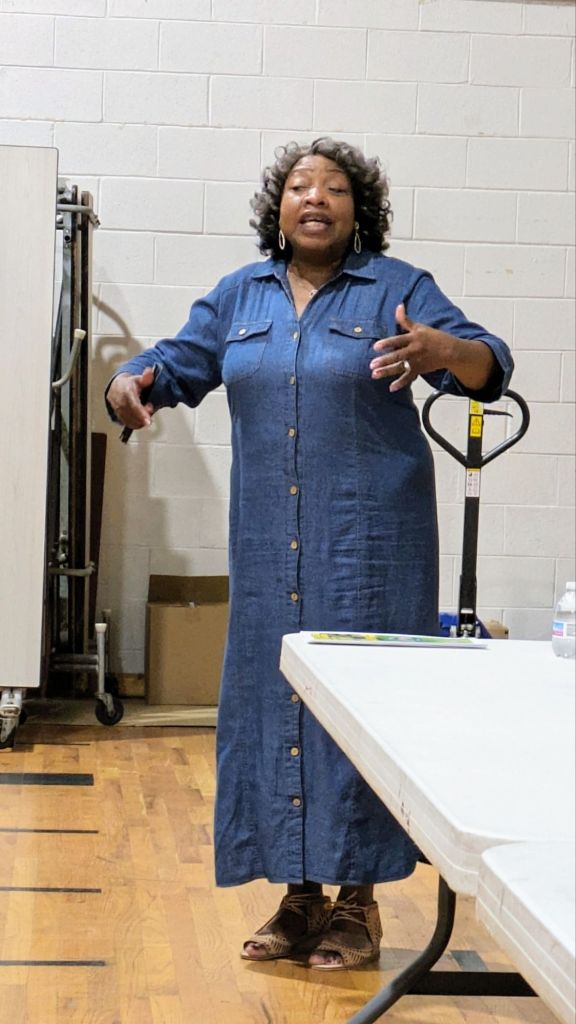
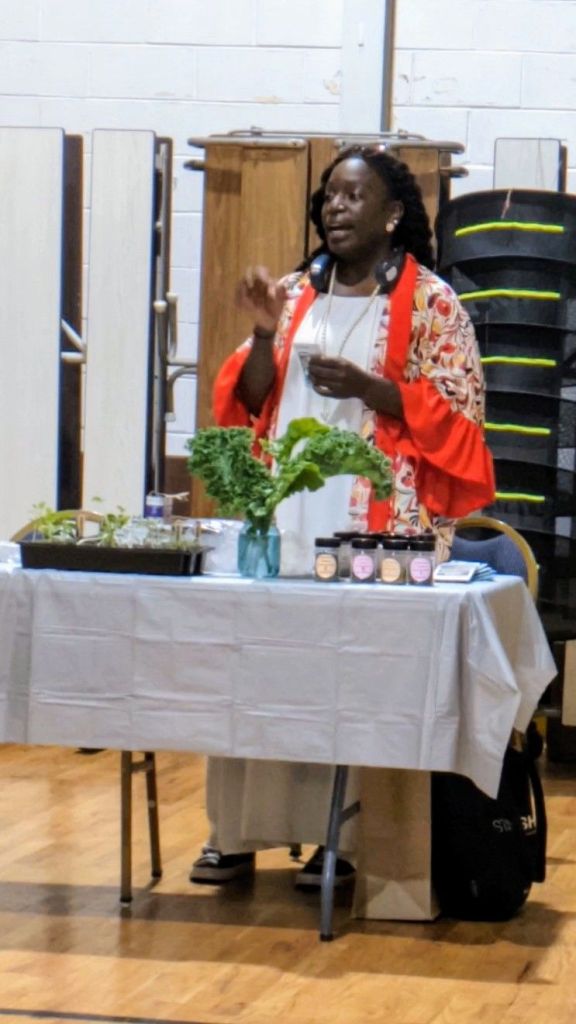
We enjoyed the program and ate lunch—which included a salad made with harvests from the garden! Melvin, the foundation’s business and community liaison, introduced everyone to one another and shared the history of the garden. Tempie, the church member who originally had the vision for this garden, thanked everyone for their part in it. She and her husband both contribute many hours to tending and maintaining the garden. Esther, who has a horticultural background and education, teaches the children’s gardening programs. She showed us what the children have been learning and doing, and she explained some helpful gardening concepts to the adults, such as proper harvesting for continued growth. Two trucks from the fire department were also part of the event this year. I think the adults enjoyed talking to the firemen as much as the children enjoyed climbing into the trucks. 

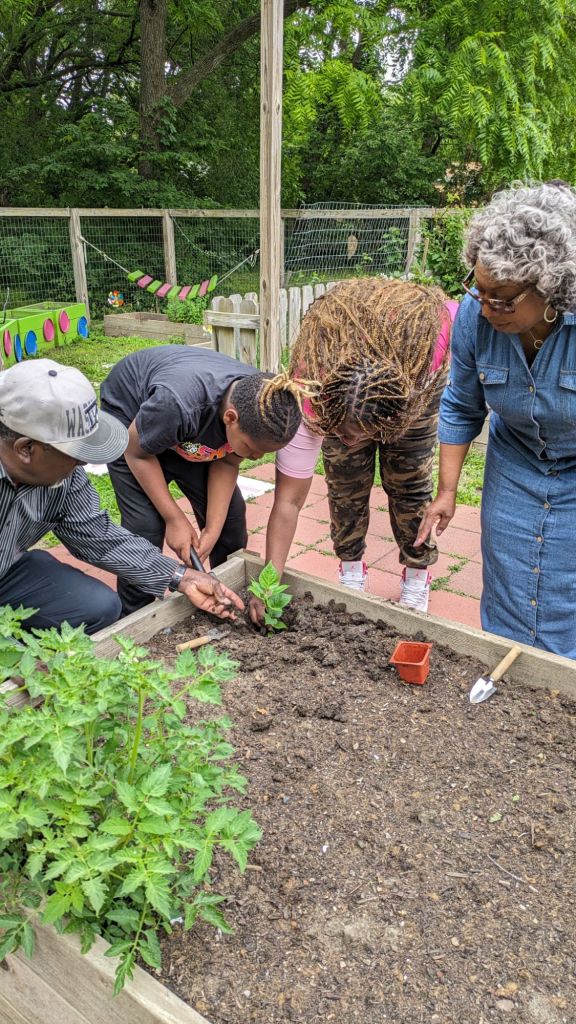
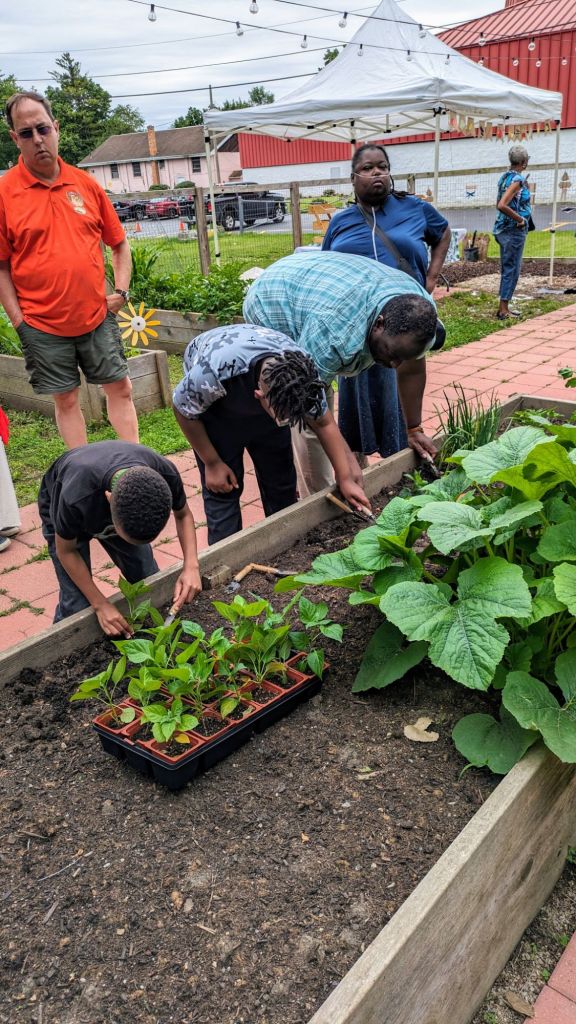
Then came my favorite part, touring the garden. Anyone who wanted to help plant something had the opportunity to do so, using the Biquinho pepper plants I’d brought along. I think the garden is looking even better than last year. Esther said arched trellises will soon be added to support tomatoes and other vining plants, and they will also provide some shade for those working in the garden. While a storm had brought down their greenhouse, a new one was just delivered and will be installed shortly. Nicor Gas donated the greenhouse, and a representative of the company was there.

Bringing everyone together for an inspirational day like this builds more shalom through the development of all these community relationships. It can also draw in more participants and volunteers. I recommend it to anyone who is involved in church community gardens and/or children’s camps. 

Christian Gardening Network

I also recommend networking with other Christian organizations and people who are involved in garden work. I learned about the All Nations Eden Community Garden and met Melvin, Tempie, and Esther through a network that I started in the Chicago area. The network evolved from a project I did for one of my classes at Bakke Graduate University. I’ve been pursuing a Doctor of Transformational Leadership degree there, as I noted on my Pray page, since I first started this blog. I have now completed all of the coursework and am working on my dissertation proposal. My dissertation is going to be on gardening for shalom, and I hope this network will be instrumental in my research.

Last year our network had both our first virtual meeting and our first in-person meeting. I’m thankful for this marvelous community garden in Joliet and for all of the other connections I’ve made through this network. If you are a follower of Jesus and are involved in any type of garden business or ministry in the greater Chicago metropolitan area, please contact me to learn more about this network.

Edible Flowers: Magnificent Magnolias on the Menu

Magnolia as Edible Flowers

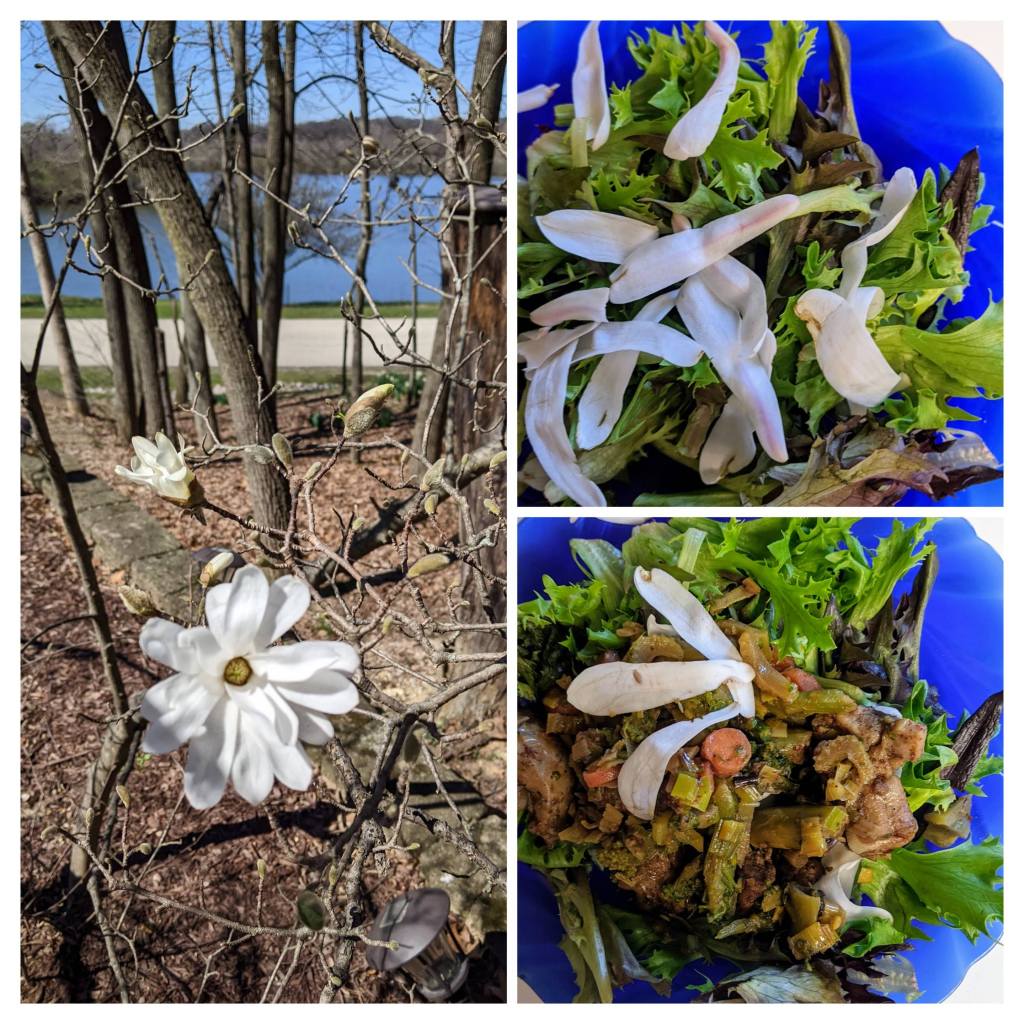
Although I’ve been growing and using edible flowers for over 20 years, I’m still learning and expanding my repertoire. Recently when I saw that a friend’s magnolia was starting to bloom, I remembered that magnolia is an edible flower. After checking with my friend to make sure she had not used any pesticides or chemical fertilizers, I popped a petal in my mouth. Sure enough—it had a slight ginger taste!

I did some research on whether or not magnolia flowers are edible after I had seen two foragers post recipes for them on Instagram. It looks like both of them used a grandiflora type of magnolia. The Plants for a Future (PFAF) database gives Magnolia grandiflora an edibility rating of 2 out of 5. It says, “The flowers are pickled in some parts of England and are considered to have an exquisite flavour. They are also said to be used as a spice and a condiment.” 

Both of the instagrammers used the flowers like one would use ginger as a spice in baking. Andrea Vanzo (@foraged.by.fern) dried and crushed magnolia petals to make Magnolia and Rhubarb Crumble Bars Alexis Nicole (@blackforager) froze some unopened flower buds so she could grate them to put an extra gingery snap in her Magnolia Snap Cookies. I would like to try one of these recipes when I get the opportunity to forage for magnolias with larger and sturdier blooms. Alas, I’m not growing any magnolias in my garden. If you are and would like to share them, let me know!

Magnolia flowers can also be used in savory dishes. PFAF gives Whitebark Magnolia a 2 out of 5 edibility rating, and says, “The young leaves and flower buds are boiled and eaten as a vegetable. Older leaves are powdered and sprinkled on food as a flavouring. Whole dried leaves are placed on a barbecue, filled with miso, leeks, daikon and shitake then broiled. The delightful aroma of the leaves permeates the miso mixture which is then served with rice.”

Other magnolias, including my friend’s Star Magnolia, have a PFAF edibility rating of 1 out of 5. That means they’re still edible—although the flavor may not be as strong. The University of Washington notes a source which says that the Lily Tree magnolia flowerbuds, which are rated 1 out of 5 for edibility, “are used in Asian cuisine. After removing the calyxes, the buds are pickled and used to flavor rice, and to scent tea.”

With my friend’s permission I took a few flowers home and decided to use them to flavor the chicken stir fry that I had for dinner. I could have mixed the petals with rice or quinoa, but instead I mixed them with organic lettuce and topped it with my leftover stir fry.  I added a few more petals on top as garnish. It was easy and magnolficent!

Easy Garden Side Dishes

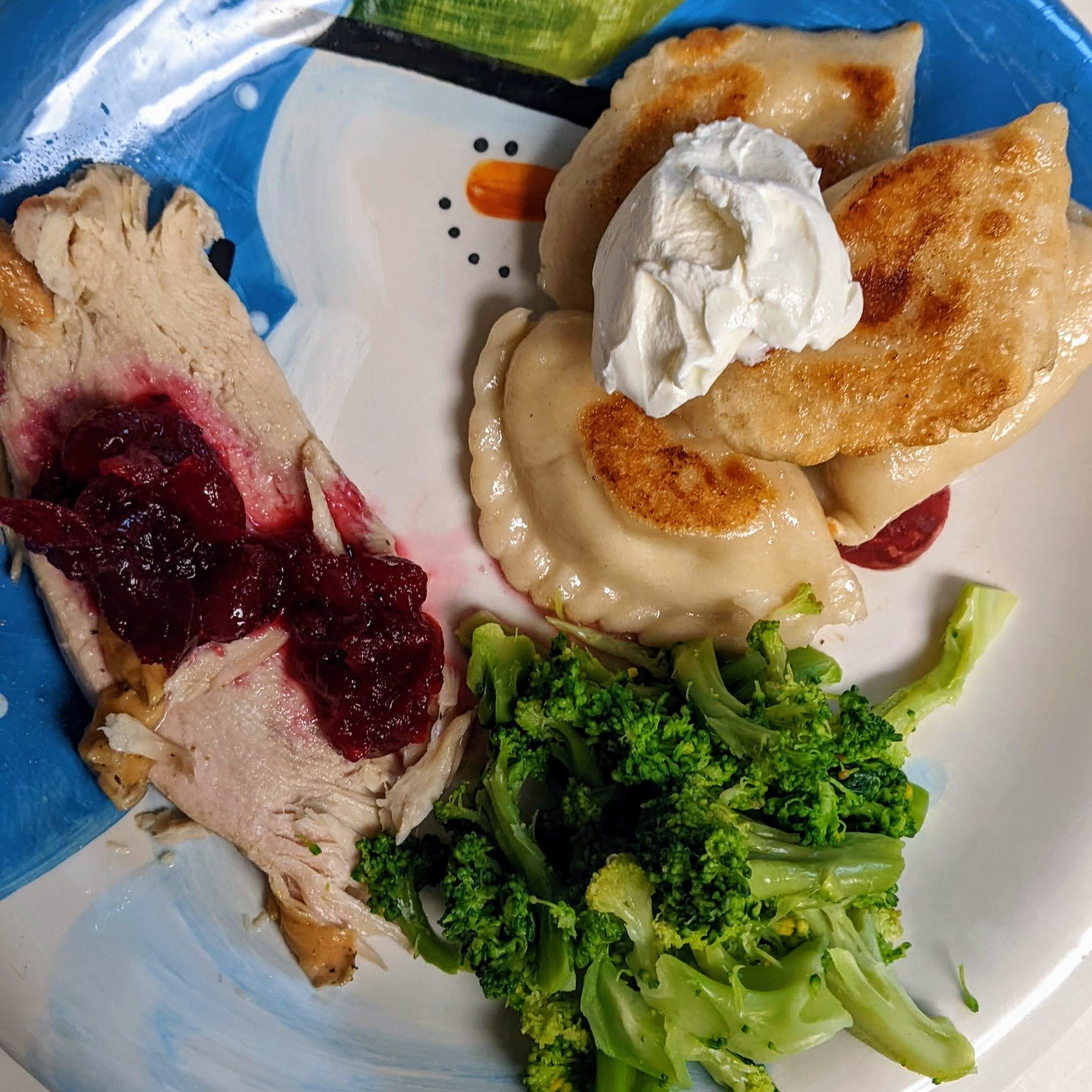
Garden Wax Beans served with Grilled Turkey (frozen leftovers) and Pierogi (from deli)

I may earn commissions for purchases made through any Amazon links in this post. See disclosure here.
Garden to table cooking doesn’t mean you have to cook everything from scratch for every meal. Sometimes the garden element could be just some dried or fresh herbs that you add in or sprinkle on top of a dish.

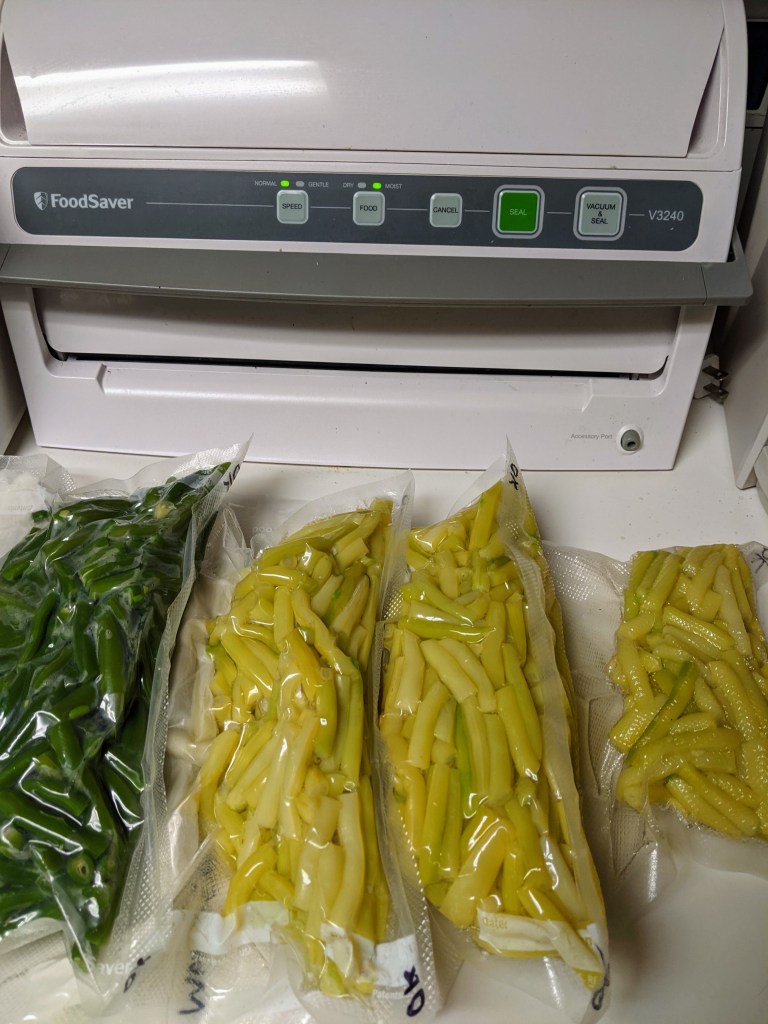
During the summer, I blanch, vacuum seal, and freeze most of the harvest of my garden’s broccoli, wax beans, and green beans. It’s summer in a bag! Then I just microwave some whenever I need a veggie side dish. Sometimes I’ll dress them up with a coat of garlic scape pesto (also frozen from my garden), a drizzle of butter or flavored olive oil, or a sprinkle of Everything Bagel seasoning. But most of the time, I just nuke and serve.

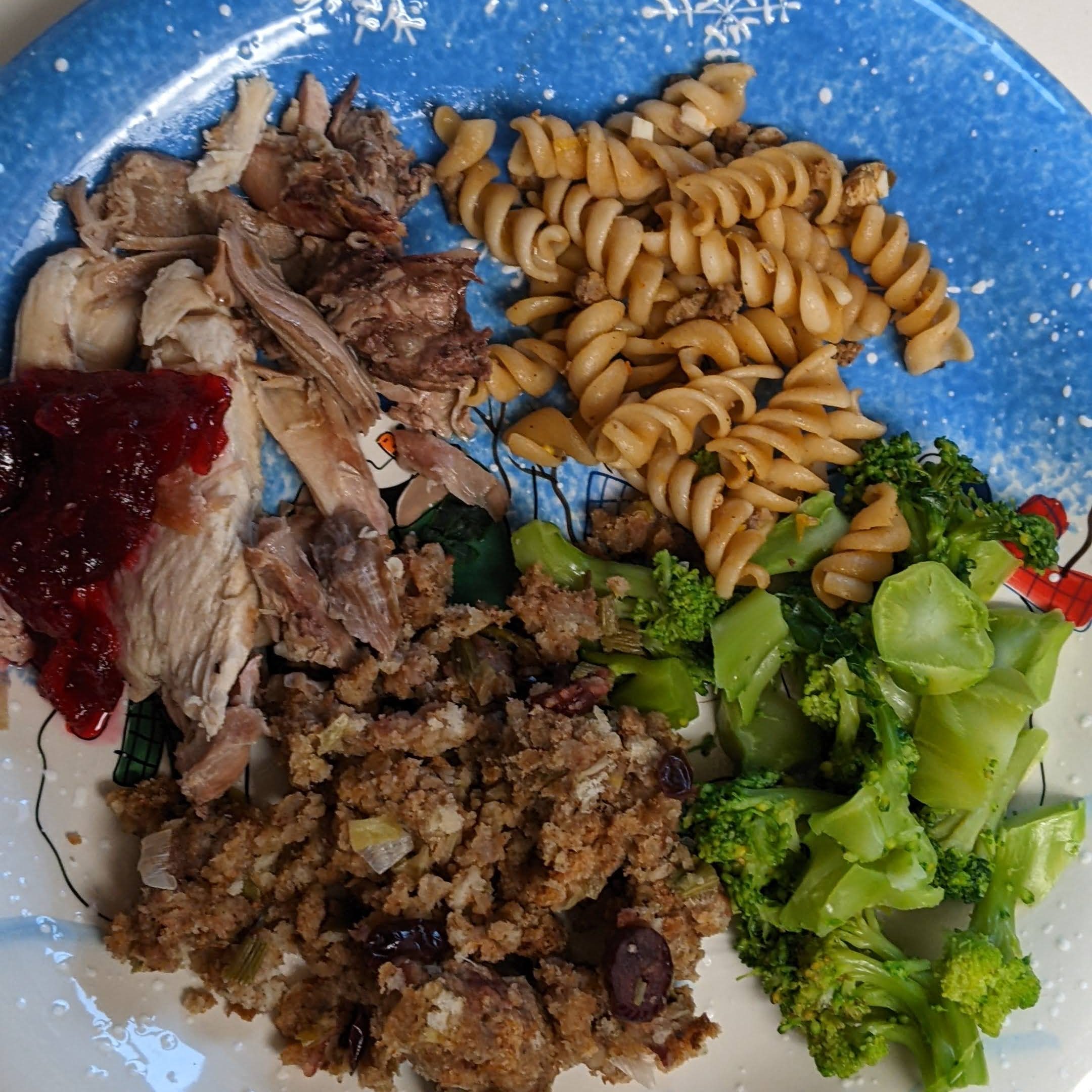
Here you can see how I combined those easy garden vegetable side dishes earlier this month with turkey leftovers (frozen from Thanksgiving) and store bought items like pierogi from a deli and a whole wheat stuffing mix that I jazzed up with dehydrated onions and celery from my garden and raisins.

The turkey leftovers, like my garden veggies, are as good as they were when I froze them several months ago because I used my FoodSaver vacuum sealer to remove all the air from their storage bags. Because it prevents freezer burn, the vacuum sealer is an excellent tool for storing leftovers as well as for preserving my precious garden harvests. I grew and preserved vegetables for many years without learning how to can. Freezing is easy, and the results are great. I can microwave them for quick and delicious meals anytime I want.

Because my freezer is stocked with organic vegetables from my garden, I don’t have to buy vegetables from the store unless I need something fresh that’s not currently growing in the garden, such as lettuce or crunchy celery. (Although I have still have dehydrated celery—which is fine for making stuffing or soups—in my pantry, it’s not crunchy and won’t work, for example, for a potato salad.) My garden usually produces enough beans to last until the next year’s harvest starts, and I’m working on getting broccoli to that point as well. The longer I can go without buying frozen vegetables, the better!

Making Rose Potpourri

from Garden Flowers and Herbs

Rose potpourri sachets made from dried garden herbs and flower petals

I may earn commissions for purchases made through any Amazon links in this post. See disclosure here.

A Creative Way to Use Fragrant Herbs and Flowers from the Garden!

Since Valentine’s Day is almost here, I’ve got roses on my mind—but they’re certainly not blooming in my garden now! There are, however, other ways to enjoy my garden’s roses even in the wintertime.  Making rose potpourri is one of them.

There are several ways to use potpourri. To scent a room, you can put potpourri in a pretty container that’s open or has holes in it. I like to put it in sachets which I can slip into my dresser drawers. Rose potpourri sachets are also beautiful and much appreciated favors or hostess gifts. When I hosted a table for a women’s luncheon held at my church a couple years ago—set with vintage pink floral china and rose-fold napkins—I gave rose potpourri sachets to the guests at my table. I made the potpourri from dried rose petals and rose thyme from my garden.

Drying Herbs and Flowers

Before you can make potpourri in the wintertime, you’ll need to harvest and dry fragrant flowers and herbs from the garden during the growing season. But if you’re in a hurry or can’t get enough rose petals from your garden, you could, of course, buy them.

Because roses are edible—if grown organically like mine are—I try to make a habit of preserving petals from my Pink Knock Out® roses every summer. Sometimes I will crystalize them to use for decorating cakes and such. But drying them is easier, so I do that more often. After washing them, I air-dry the petals on paper towels spread over a baker’s cooling rack. I could use my dehydrator to dry them faster, but it’s not necessary since this air-dry method works well. The petals’ color deepens when I dry them. When the petals are completely dried, I stored them in a vacuum sealed jar. Dried rose petals can be used for baking as well as for crafts like potpourri. By February, my dried roses petals have lost much of their color, as well as some fragrance, so I would not use them for baking at this point.

It’s nice to have some rose scented leaves in the potpourri as well, but you may make it with all rose petals of that’s all that is available to you. I highly recommend rose-scented geranium leaves. My rose geranium, however, is not in the best condition at the moment. I need to take some cuttings from it and start new ones. Fortunately, I have a healthy patch of rose thyme in my herb bed which I could use instead. I didn’t have any dried rose thyme in storage, so I went out on one of our warmer 40-degree days in early February and harvested a bunch. Then I washed and air-dried it by laying it out on a screen or baker’s cooling rack.

Other supplies

Keep in mind that you’re not limited to rose potpourri. You could use lavender or any other blooms from your garden. You could even mix different scents! But choose scents that you can enhance with essential oils and get the oil you wish to use. I used rose oil.

You should also buy or make the sachet bags or whatever containers you plan to use for the potpourri.

Rose Potpourri Ingredients: Rose Thyme, Rose Petals, and Rose Essential Oil

How to Make Potpourri

First, gather all of the supplies noted above: fragrant dried flower petals and/or herbs, essential oil with the same scent, and sachet bags or other containers for the finished potpourri. You will also need an airtight container—I use a zip-seal plastic bag—for mixing the potpourri and a scoop or spoon for filling the sachets.

Second, mix the potpourri ingredients. If there are woody stems in your dried herbs, remove the stems first. I used scissors to snip clusters of thyme leaves off their stems. At this point, the rose thyme began to release more of its scent, which is just like roses. Once the herbs are prepared, mix the dried petals and leaves together. Place them in an airtight container and add a few drops of essential oil. Seal the container, shake it up, and then let it sit for at least 24 hours.

Third, scoop the potpourri into the sachet bags and close them. If you like, you may decorate your potpourri bags or containers. When I made these as favors for the tea party luncheon, I printed tags and tied them onto the sachets with pink ribbon. Then, until I was ready to pass out these gifts, I stored them in the same zip-seal plastic bag that the potpourri had been in. This kept the scent from dissipating.

Here’s a video that shows how I make rose potpourri sachets. (Click this link to watch it on YouTube if you prefer.)

For more ideas on how to use roses when you’re cooking and entertaining, read my post about throwing a rose tea party: Everything’s Coming Up Roses.

Plant Propagation from Leaf Cuttings

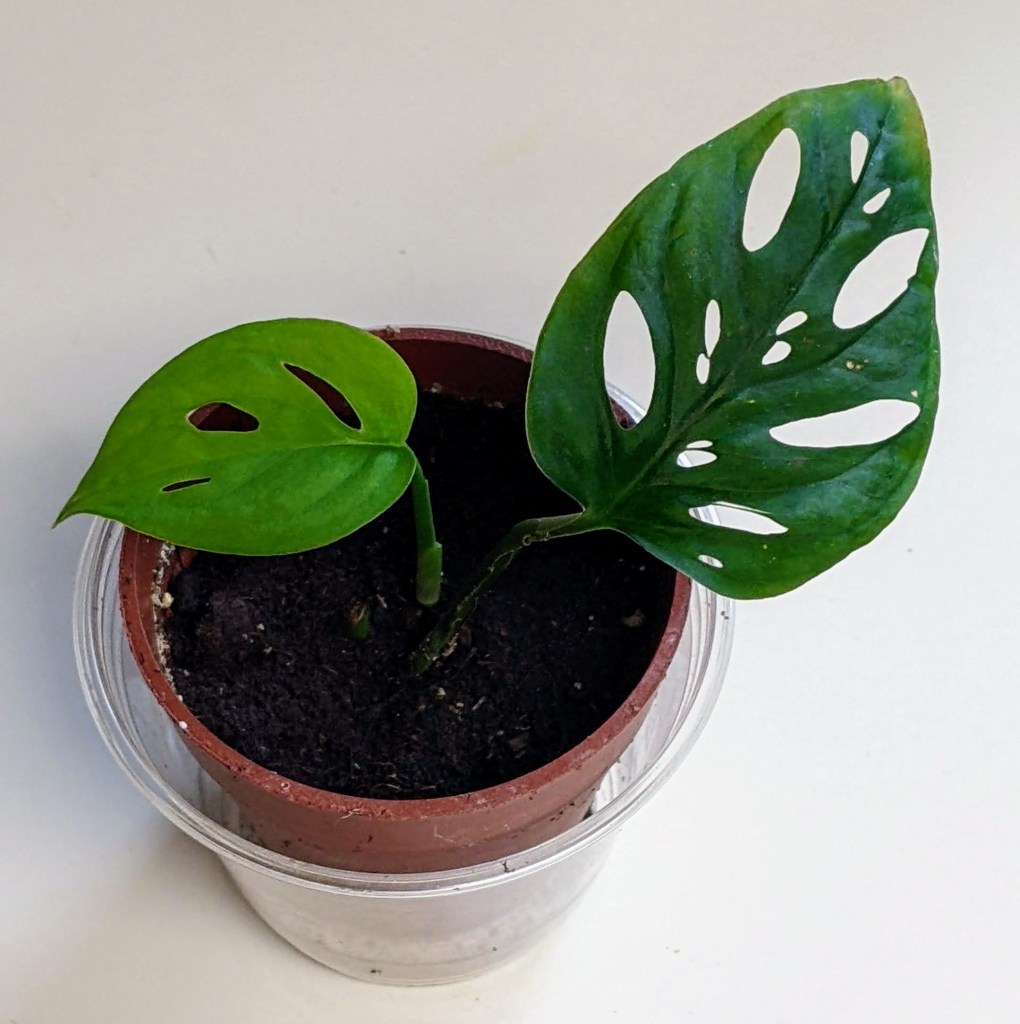
Here’s my Swiss cheese plant, four months after starting it from a single leaf and node.

I may earn commissions for purchases made through any Amazon links in this post. See disclosure here.

I’m celebrating National Houseplant Day today, January 10th, by sharing an easy way to get free plants. Propagate them yourself from leaf cuttings! I usually do this by taking cuttings from my own plants, but sometimes a friend will share a cutting. A few months ago, my local library held a plant swap, and I came home with several cuttings as well as a few plants that were already rooted and potted up. The one that I was most excited about was the smallest: a little leaf and node cutting from a Swiss cheese plant, Monstera adansonii.

I did not have any monstera, so I was excited to see this little leaf show up at the plant swap. The leaf was connected to a tiny bit of stem, maybe 1/8 inch, on either side of it, and that’s where the node is. This was wrapped in a damp paper towel. I took it home and potted it right away. First I applied a little rooting powder to it. This powder is not absolutely necessary, and I usually don’t bother when I’m starting more common plants, like geraniums, for example. But it does help the propagation process, and I wanted to do all I could to ensure success with this little beauty.

My plant with its original leaf plus first new leaf

I planted it in a small plastic pot filled with potting mix. Then I watered it and let the water drain out before placing the pot inside the plastic cup the cutting had sat in. I kept this pot in my kitchen where I could keep an eye on it over the next few weeks. About two months later, a second leaf had grown. Success!

When another leaf started growing, the first original leaf yellowed and fell off. Now, my plant has two leaves and third one that has come up and will soon uncurl. (See video.) This process not only saves me money, but it’s fun to watch. What once looked like a single tiny leaf that couldn’t amount to anything is now well on its way to becoming a vine that will continue to grow for years. I hope.

Plants are not immortal, and I tend to be a very neglectful plant mom. If you watch my recent videos showing the houseplants among my Christmas decorations and my snowman collection, you’ll see some of the plants that died on me this year. So it’s a good thing that I replenished my supply of houseplants at that plant swap! The other cuttings which I got, a couple snake plants, have not shown any new growth yet. I’ll just have to be patient. Meanwhile, I’m thrilled to have my first monstera.

What about you? Have you tried propagating any plants lately?

2023 Garden Review

The Gardener Wife saying goodbye to Mrs. Greenbeans at the end of the gardening season

I may earn commissions for purchases made through any Amazon links in this post. See disclosure here.

Let’s look back and see what happened in my garden this year. Where I can, I’ve included links to my YouTube videos, so you could click on those for more details.

January

I actually harvested some spinach from my new bonus bed—a great winter gardening success! The spinach in that bed, planted last August, started growing again in early spring, so I was harvesting it for several weeks before my spring planted spinach grew.

February

I organized my seed stash and helped to sort seeds for my local Extension Service’s seed fest. I also hosted a winter sowing display at a local environmental organization’s seed swap event. Meanwhile, mealybugs infested some of my indoor plants, but I caught them early and posted a video: How to Get Rid of Mealybugs.

March

March was a month of several firsts! I was invited to participate in my first online summit—the Hobbyscool Harvest to Table Summit. For that I prepared a 20-minute presentation on Growing Herbs in Containers and a PDF guide to go with it. By the way, the parsley I potted up for that event is still alive, almost a year later. 

Stay tuned because I’m going to be in next year’s Harvest to Table Summit! This time I’ll be talking about winter sowing.

Promotion for 2023 Harvest to Table Summit

This month we held the first meeting of the new network I’ve formed for Christians in the Chicago area who are working in any kind of garden related job or ministry. This first meeting was a virtual one.

Also in March, I became the president of my garden club, the Palos Heights Garden Club. And I finally started this year’s winter sowing, the latest I’ve ever done it, but that’s OK because—even though it’s called winter sowing—it can be done at any time of year. I began some indoor seed starting at the same time.

April

On April 8th, I spotted my first butterfly of the year—a Red Admiral. Ten days later I direct sowed snow peas, spinach, lettuce, and radishes in the raised beds of my victory garden. Given how the weather has been, I wish I’d started earlier, but last month was pretty busy. Fortunately, I was able to start harvesting spinach already from my winter garden!

May

I finally planted broccoli in mid-May before going on to plant the warm season crops later. Here’s a mid-May tour of my Slava Ukraini Victory Garden. It seemed like a late start for the broccoli, but I did get a great harvest from them at the end of the summer and early fall. I also started marigolds in the greenhouse shelf stand in my driveway. These did better than the ones I direct sowed.

Also in May, robins began nesting in a wall container on our deck. We did not name them this time because the last we had robins nesting here, I saw a hawk grab and carry poor Beatrice away. Although I enjoyed watching and filming these nestlings as they hatched and the parents began feeding them, I did not post about them until they fledged.

June

The robins on our deck fledged from their nest on June 2nd, and I caught part of the adventure on camera. 

In early June I finished planting the warm season crops in the victory garden and set up the supports for them. Meanwhile, I harvested lots of spinach and amaranth, and I made my annual batch of Chive Blossom Vinegar. 

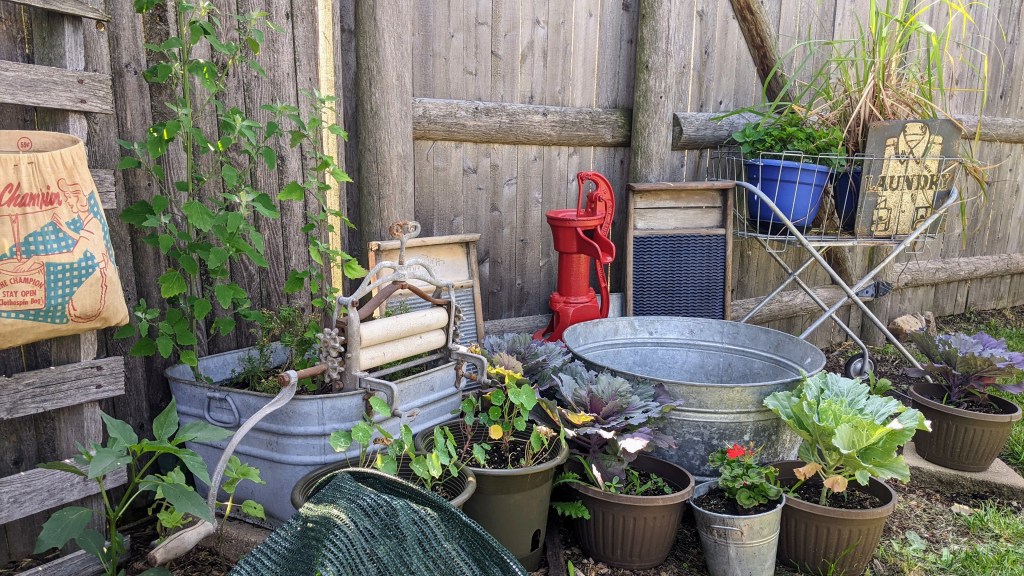
And my husband finished stripping and painting the antique water pump I bought at a backyard garden sale last month. Even though I’ll continue to collect washtubs and other laundry items, I consider this bright red pump to be the finishing touch on my Wishy Washy Washer Woman Garden. It was ready in time for our 4th of July party.

Wishy Washy Washer Woman Garden with its latest addition, the red water pump

On June 25th—after several days of horrible airline delays—we arrived in Tegucigalpa to join our Bakke Graduate University class for the Honduras immersion course. I took hundreds of photos of the plants and scenery as well as of our group’s exploration of various ministries, but I have yet to post them. What I found most botanically interesting was all of the orchids and air plants growing on trees. There were tillisandia growing on the electric lines all around the city!

July

We returned from Honduras on July 2nd, just in time to get ready to our annual 4th of July party. The garden was in good shape as the setting for this event because family and friends had watered and harvested while I was away. Here’s how the kitchen garden looked in mid-July

In addition to harvesting garlic and the first five or six heads of broccoli, started harvesting wax beans, tomatoes, and Prima apples. The winter sown chamomile that I’d planted last year started producing after the chamomile a friend gave me had quit, so I harvested and dried lots of chamomile flowers for tea this year. I harvested lots of gooseberries and black currants, too, and I canned black currant jam for the first time. Another big first for this year was successfully growing butterfly pea flowers, which I also dried for making tea later. At the end of the month I finally harvest the first cucumbers I’ve grown in several years.

I enjoyed a local garden walk in my town this month. Meanwhile the sunflowers in my kitchen garden and many other blooms in my ornamental gardens created beautiful displays all around our front and back yards.

August

This month started off with a trip to Minneapolis for my first in-person GardenComm (Garden Communicators International) conference. The garden tours were amazing, but once again I could not keep up with posting all of my photos. I did share my own garden when I got back—and how it was cared for in my absence. 

A couple days after my return, my garden club and I visited the Gardens at Ball. Ball Seed Company had been one of the sponsors of the GardenComm conference, so this was extra interesting for me.

This was the month that my husband completely rebuilt my strawberry bed, and I planted it. The new bed is a little deeper and bigger. The victory garden continued to produce lots of tomatoes, Malabar spinach, As I continued to harvest and water the garden, I kept using or preserving everything I harvested. I also weeded, deadheaded, and pruned the garden when I could. And I had to remember to keep watering my indoor houseplants!

Cover of Nina Koziol’s upcoming book

On one Saturday morning I went to a tea foraging workshop. With all the chamomile, mint, pineapple mint, and my first butterfly pea flowers, this has been a big year for me growing tea! In the afternoon I visited my friend Nina Koziol’s garden. I recommend you keep an eye out for the two books she has coming out this next year: White Gardens and Ultimate Guide to Small Space Kitchen Gardens. The kitchen gardens book has a picture from MY kitchen garden on its cover!

By the end of the month, I planted some cool crops for fall—lettuce, radishes, beets, and snow peas. Once again, the fall snow peas were a bust.

September

This Late Summer Kitchen Garden Tour shows how my victory garden looked in early September. This month’s harvests included tomatoes, cucamelons, eggplants, wax beans, green beans, broccoli, peppers, celery, Malabar spinach, and the first head of red cabbage. This month I canned some pepperoncini and Biquinho peppers and froze some garden tomato sauce. I’ve been freezing many tomatoes whole to use in cooking or canning later as well.

I visited two gardens, a local dahlia fan and a new network member who donates his farm’s produce to local food pantries. Girl Scouts came to visit my garden, and I helped them with their gardening badge. I set up my two fairy gardens just in time for their visit. I also hosted a brunch tea party early in the month and an evening cookout later in the month—both ended up in the Mackinac Island Garden in my side yard.

October

We had a first frost alert in the middle of the month, which caused me to harvest almost all of the remaining tomatoes, peppers, and eggplant. However, there wasn’t much damage, so I was able to keep harvesting cucamelons, beans, broccoli, Malabar spinach, lettuce, radishes, and radish greens throughout the rest of the month. I planted garlic near the end of the month.

We got our real first frost at the end of the month, plus our first snow on Halloween. Before that happened, I harvested another big round of green tomatoes to ripen indoors. I dehydrated most of the cherry tomatoes from these last two harvests. I harvested the leeks and celery, too, because I didn’t want to deal with them later in the cold. 

November

Since first frosts have been coming later and temperatures have been averaging warmer and warmer for years, it was not a big surprise to learn that my area has moved up another half-zone, from 5b to 6a, when the USDA put out a new Plant Hardiness Zone Map this month. 

November began with me harvesting what I could after that first snow. I decided to keep growing the Swiss chard in the bonus bed and napa cabbage in the Wishy Washy bed under cover now. Since we still had quite a few warmer weather days left, I started cleaning up the kitchen garden slowly. One one of those days, I collected marigold seeds from the dried seed pods. I kept the cabbages and broccoli going until the end of the month, until we finished putting the garden to bed right before Thanksgiving. While my husband worked on the kitchen garden, I cleaned up the ornamental beds. After Thanksgiving, I began working on my winter containers.

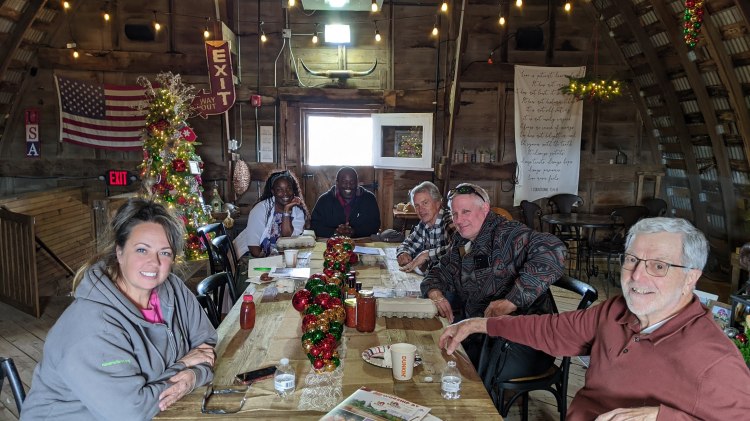
By the way, my network had another first this month—our first in-person meeting, held at Navarro Farm.

In-Person Network Meeting at Navarro Farm, Frankfort, IL
December

Another exciting first for me was my first collaboration with other garden influencers. Heather’s team at Garden Thoughtfully put together a video of a Gardener’s Favorite Things. You’ll see mine, a plant dolly for moving heavy containers, at the 0.52 mark. I love all of these gardeners’ favorite things!

Thanks to those green tomatoes that have slowly been ripening indoors, I’ve had fresh tomatoes for our salads all the way up to December this year. And thanks to the frost cover over my bonus bed, we’ve had fresh Swiss chard all the way through to the end of this month and more.

You can see how a number of my indoor houseplants have fared and how I’ve incorporated them into my holiday decorating here. I still have more in other rooms all over the house. Many of them could use a repotting and more attentive care, but I’m happy if I can just keep most of them alive through the winter. My two rosemary plants that have survived about 5 years now are a big triumph!

Well, there you have it—proof that I do indeed garden all year round! I’m looking forward to an even better year of gardening in 2024. Happy New Year!

Bloom!

First Sunflower Bloom of the Year

Good morning from my kitchen garden!

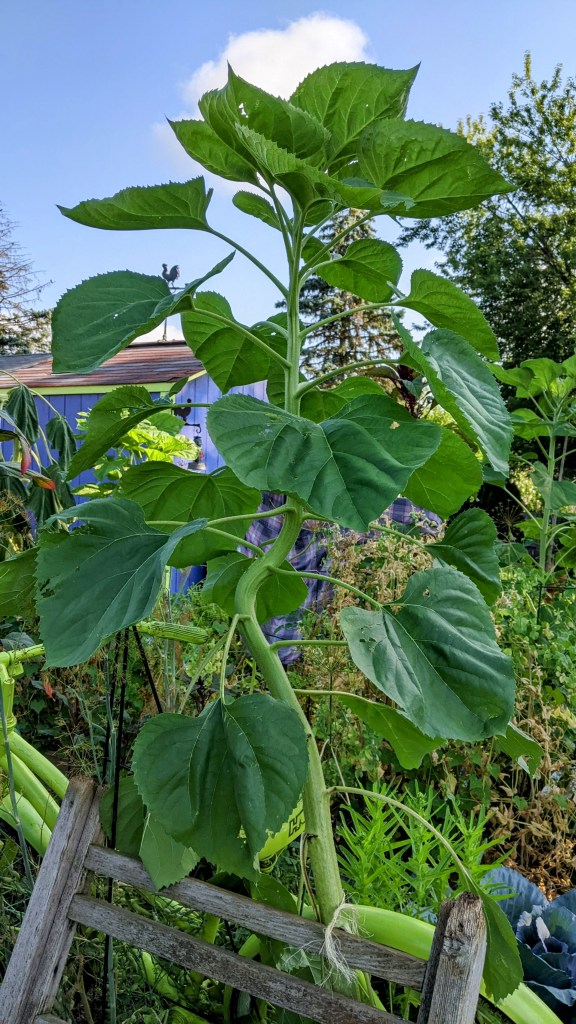
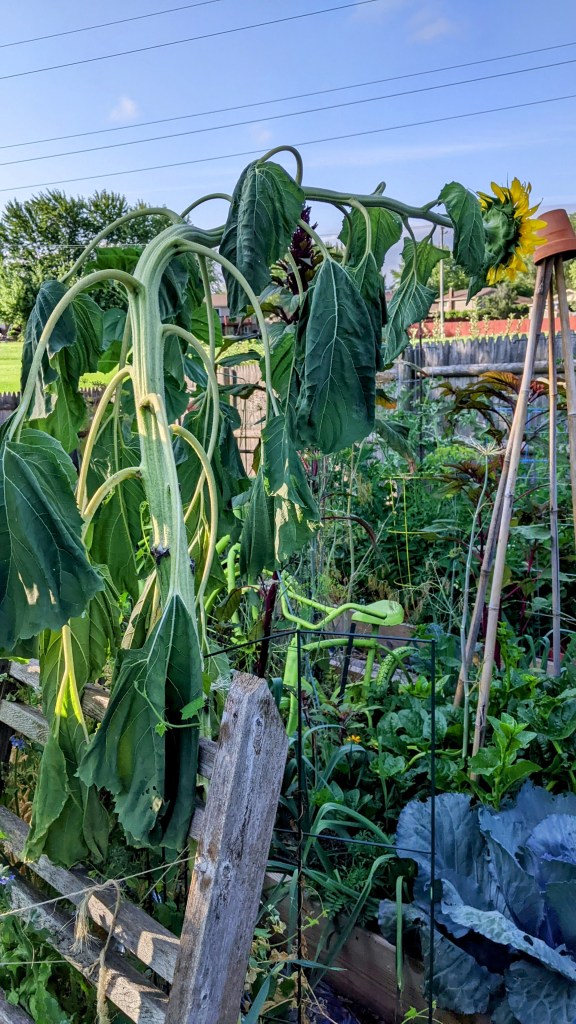
The first sunflower to bloom for me this year is on a pretty sad looking plant. It got knocked over during a heavy rainstorm and then started growing crooked. Ever since I propped it back up (see my Summer Kitchen Garden Tour), its leaves have been wilted. Yet it blooms!

This beautiful flower is praising the Lord just by doing what the Creator designed it to do, no matter what trouble it’s had. And with the help of the Holy Spirit, we also can be what our Lord has called us to be—no matter what twists and turns we face in our lives. “And we know that all things work together for good for those who love God, who are called according to his purpose,” (Romans 8:28 NET).

The other side of that sunflower, bent over and propped up

I’m in need of this kind of encouragement! It’s been a long time since I’ve posted in this blog or sent out my newsletter. That’s partly because I have a computer problem which is still unresolved (I’m using my phone to post this) and partly because my doctoral classes have consumed much of my time. So it feels like my work has fallen over and gone a little crooked.

Yet according to the passage leading up to Romans 8:28, I can still live by the Spirit and seek the Kingdom of God—just like my sunflowers kept reaching for the sun after the storm pushed them over. No matter what my circumstances, I am to have my “outlook shaped by the things of the Spirit. For the . . . outlook of the Spirit is life and peace” (Romans 8:5-6 NET). The Amplified Bible describes the Spirit’s outlook of life and peace as “the spiritual well-being that comes from walking with God—both now and forever.” If Paul had written this letter to the Roman believers in Hebrew, I think he would have used the word shalom. This Hebrew word means not only peace but welfare and wholeness. The shalom life is available to all who have been set free by Christ Jesus and now have the Spirit of God in them (Romans 8:2-17). Even though we live in a world that is trapped by sin and death, we know that “we have complete victory through him who loved us!” (Romans 8:37 NET). No matter what, we will bloom!

I’ve leaned away from my blog and newsletter, propping them up with a sporadic post or email here and there during the last couple of years. But I assure you that I’m still growing and blooming. And I didn’t have to set my passion for gardening aside, for I’ve continued to talk and write about gardening in my graduate classes. Every time I think about how God could use me to bring transformational change to the world around me, gardening is the answer. After all, my sunflowers, my garden, and all of creation, as Paul explains in Romans 8:18-25, are eagerly waiting for transformation, for God’s perfect shalom. That’s what God has planned for his people and his creation. While we wait for the ultimate transformation, we should walk according to the Spirit and enjoy the love of God in Christ Jesus our Lord.

Another sunflower that I propped up—its leaves aren’t wilted

Here’s an update on how I’m doing that through my studies. One of the things I’ve done as a result of my classes is to form a network of Christians in the Chicago metropolitan area who are involved in any kind of garden related work. If you or someone you know fits that description, please contact me. The sooner you can get involved in the network, the better. I’m sure there are many more believers out there in the gardening world, but we don’t all know each other. I want to change that and to open up a channel of communication among us. Those who are not in the Chicago area could help this project by joining the prayer support team for it.

The next step in my doctoral program is to take the first of the courses which will guide me through writing my dissertation. That class is not offered this quarter, so I’ve got a little break until October to do other things, such as writing this post. I wish I could say that I’m propping this blog back up for good, but I know that working on my dissertation will make it even harder for me to do much blogging. However, I’ll still be writing about gardening. I don’t know how it will work out, but my idea for this dissertation is to explore how to use gardening to bring shalom to our communities.

Whether I’m working in my garden, or on this blog, or on my dissertation—whatever I’m doing—I’m blooming, just like that sunflower in my kitchen garden! Its leaves are wilted, and I may be, too; for I don’t always have my act together, and graduate school is hard. That poor sunflower may not be straight and tall, but it’s doing what the Creator designed it to do—and so will I. God’s purpose is going to work out ultimately, and it’s going to be glorious because our Creator is glorious.